





Aboriginal and Torres Strait Islander listeners are advised that the following podcast and show page contains information about people who have died.
In this episode of Biographers in Conversation, the acclaimed historian and author Professor Clare Wright OAM chats with Dr Gabriella Kelly-Davies about her choices while researching and writing Näku Dhäruk The Bark Petitions: How the People of Yirrkala Changed the Course of Australian Democracy.
Meaning of Näku Dhäruk
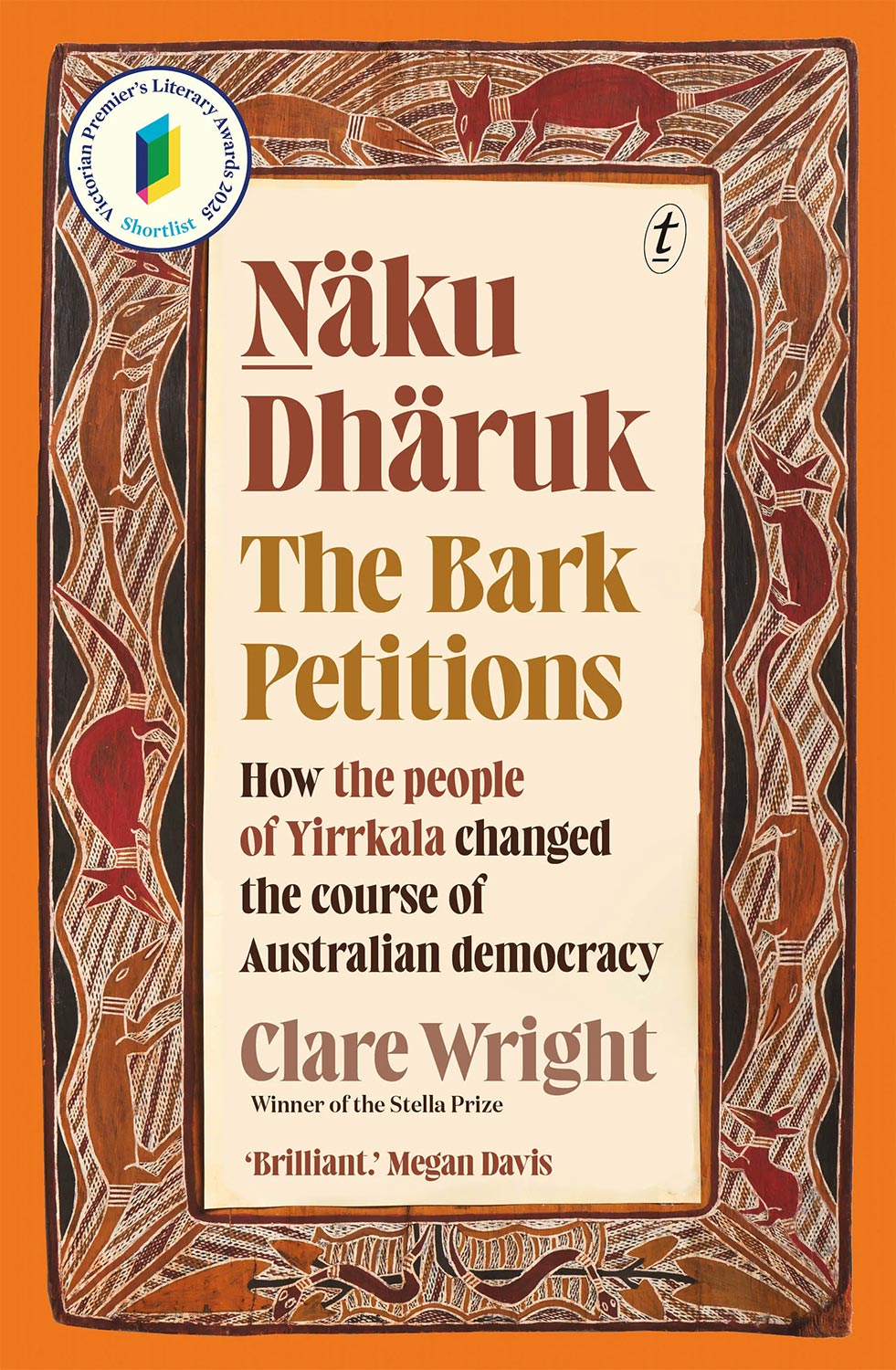
Winner, The Australian Political Book of the Year, 2025
Winner, Queensland Literary Awards: University of Queensland Non-Fiction Book Award, 2025
Winner, Northern Territory History Award, 2025
Shortlisted, Prime Minister’s Literary Award, Australian History, 2025
Shortlisted, Victorian Premier’s Literary Award, Non-Fiction, 2025
Shortlisted, Age Book of the Year, Non-fiction, 2025
Shortlisted, NSW History Awards, Australian History Prize, 2025
Shortlisted, Walkley Book Award, 2025
Ṉäku Dhäruk The Bark Petitions
Clare Wright’s Näku Dhäruk The Bark Petitions completes her acclaimed Democracy Trilogy with a work that fundamentally reimagines what it means to have a voice in Australian democracy. The book chronicles the extraordinary events of 1963, when Yolŋu Elders in northeast Arnhem Land created four bark petitions protesting bauxite mining on their sacred lands, an act that would spark a decades-long struggle for Indigenous land rights and sovereignty.
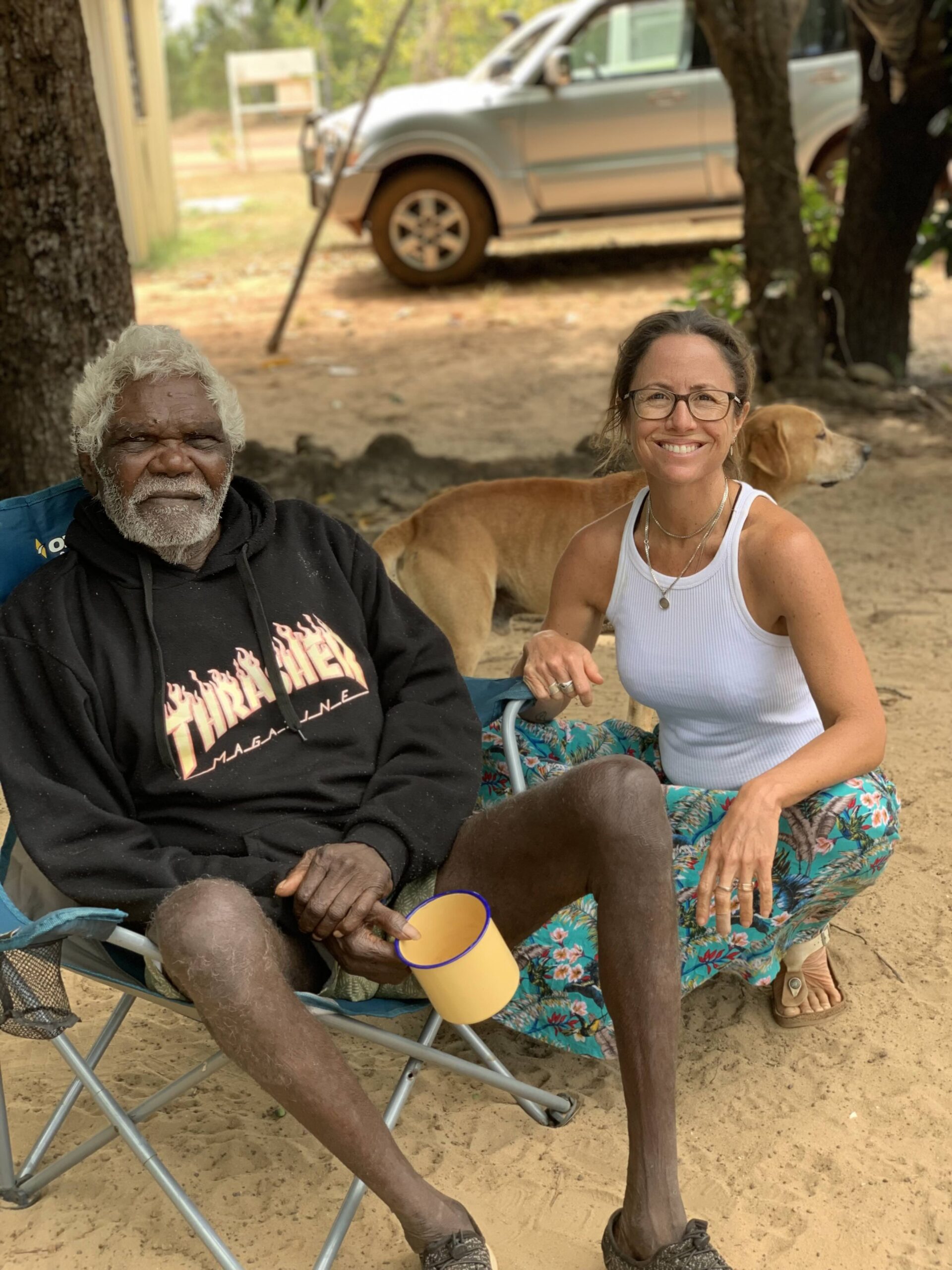
Clare with Mr Munuŋgurr (now deceased), last surviving signatory of the Ṉäku Dhäruk at his homelands in Garthalala, NT, 2021.
Wright’s relationship with this story is deeply personal. Culturally adopted into the Yunupiŋu family during her time living on community in northeast Arnhem Land from 2010, she was approached by the late Galarrwuy Yunupiŋu to write this history collaboratively. What emerged is far more than historical documentation. It is a kaleidoscopic narrative that weaves Yolŋu cosmology, oral histories, archival research and political activism into a singular meditation on what democracy means when viewed from the ground up.
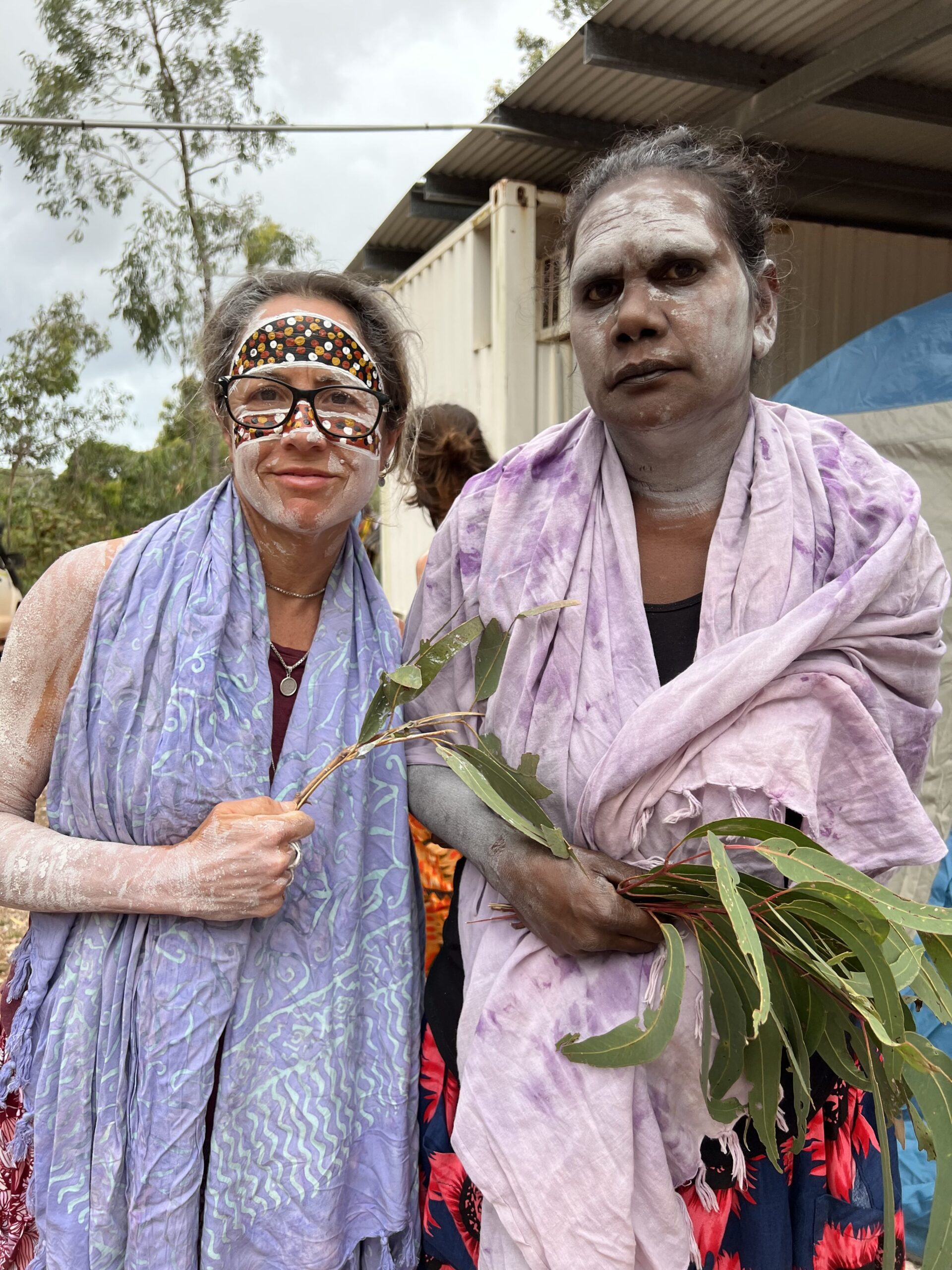
Clare with her yapa, Valerie Ganambarr, the woman who culturally adopted her in 2010.
Ṉäku Dhäruk The Bark Petitions’ structure mirrors this duality of perspectives. Wright crafted the narrative chronologically through the twelve months of 1963, simultaneously layering the six Yolŋu seasons and the cyclical concept of the ‘Everywhen’, where past, present and future exist in constant conversation. This choice reflects her commitment to writing in two worlds, honouring both Western linear time and Yolŋu epistemology.
Unique Narrative Structure
The title itself embodies this principle. Ṉäku Dhäruk translates as ‘message on the bark’, a profoundly different concept from petition. As Wright explains, petitions flow upward from the powerless to the powerful, carrying the language of supplication. But the Yolŋu understood themselves as one sovereign nation negotiating horizontally with another, attempting to establish what amounted to a treaty between equals. They were asserting, not begging.
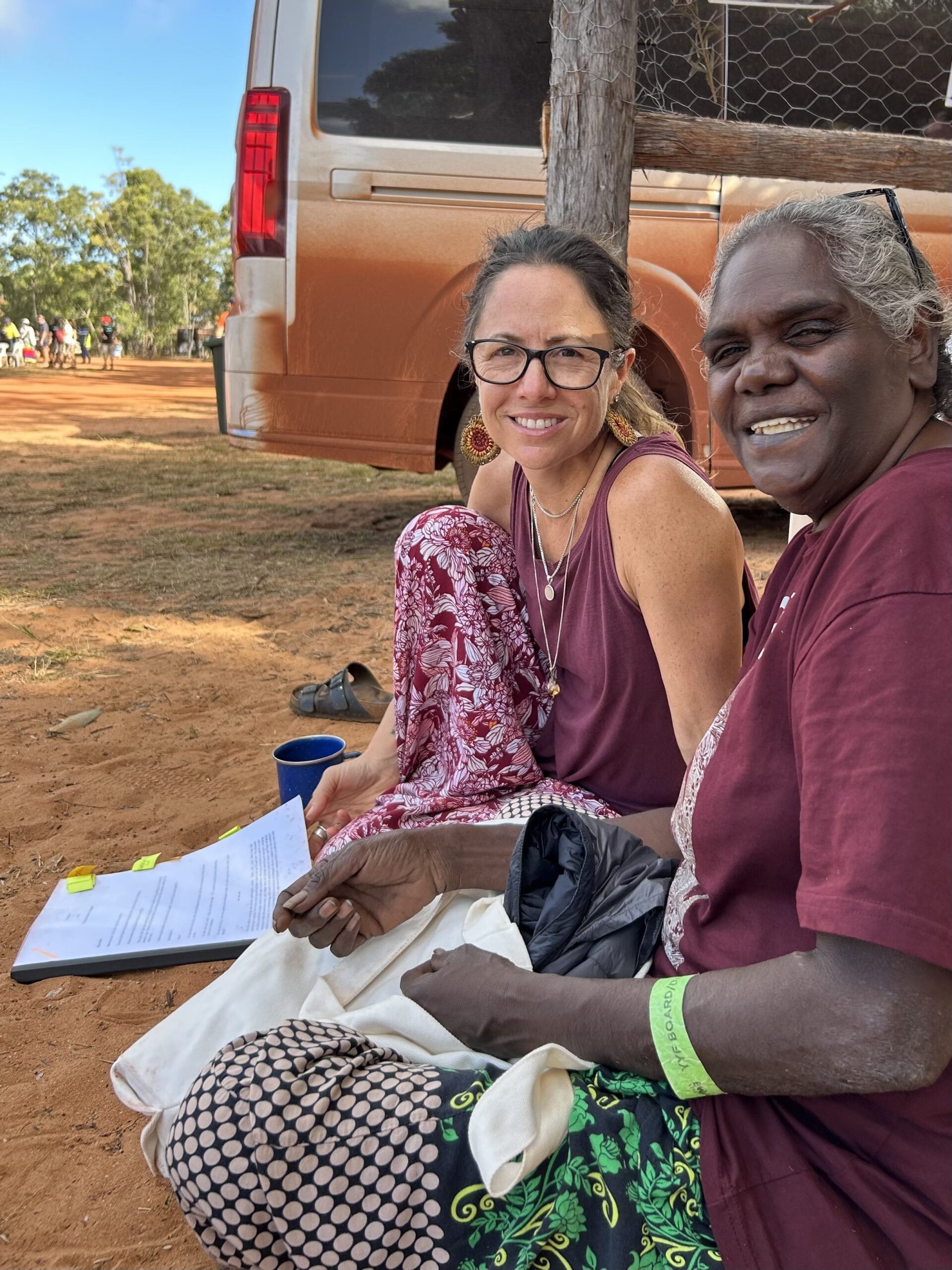
With Yananymul Munuŋgurr, whose father was a young man when he signed the Ṉäku Dhäruk. Yananymul called the fourth ‘missing’ petition, “our lost treasure” and worked closely with Clare and the community to repatriate it from Derby, WA to Yirrkala in December 2023.
Wright’s methodology was equally unconventional. Rather than constructing the narrative from omniscient hindsight, she wrote in fragments from interviews, mining maps, parliamentary debates, photographs of gum trees and her own sensory memories of Country. She laid these fragments across her office floor like puzzle pieces, assembling them day by day, guided only by what her historical protagonists knew in each moment. The result is a propulsive narrative that pulls readers through a story whose outcome, though history, feels urgently unknown.
Ṉäku Dhäruk The Bark Petitions resonates powerfully in contemporary Australia, particularly following the failed 2023 Voice referendum. Wright waited to write her epilogue until she witnessed how First Nations communities would respond to that outcome. In her closing passages, she gives the final word to Yolŋu Elder Djapirri Mununggirritj, daughter of one of the petition makers, who describes the bark petitions as a memory bank you can click on, an analog internet of Indigenous knowledge, sovereignty and resistance.
Näku Dhäruk The Bark Petitions challenges how we understand Australian political history. This is not Aboriginal history set apart, Wright insists, but Australian history with First Nations people and their perspectives rightfully centred. The book’s recent recognition as Australian Political Book of the Year confirms that the nation is beginning, however slowly, to embrace this truth.
As Wright reminds us, democracy is never inevitable. It is fought for, day by day, by ordinary people making choices about what they value. The Yolŋu Elders who painted the bark petitions in 1963 were doing precisely that, asserting their voice, their law and their sovereignty. Sixty years later, that soft flame continues to draw us in.
Praise for The Bark Petitions
‘A dazzling conclusion to [the] Democracy Trilogy…Both a triumph of storytelling and a near-unparalleled feat of two-worlds thinking, this book—and the Trilogy—will stand as a milestone in Australian history.’
Yves Rees, Best Books of 2024, Spectrum
‘This is officially the first history of the Uluru Statement era: the very messy story of power, subjugation and co-existence told by a brilliant historian. Clare Wright pioneers a way forward for the nation, starting with voice. The genesis of the right to be heard started with a bark petition.’
Professor Megan Davis, Scientia Professor & Balnaves Chair in Constitutional Law, UNSW
‘A masterful and definitive account of one of the most important political documents in Australian history. Wright brings to life this moving story of unwavering Yolngu resistance and the enduring legacy of their political actions.’
Larissa Behrendt, Distinguished Professor, UTS
‘Stunningly beautiful…I am in awe of this book. It’s like nothing I’ve ever read.’
Prof. Frank Bongiorno, author of Dreamers and Schemers: A Political History of Australia
‘A masterpiece.’
Thomas Mayo, co-author of The Voice to Parliament Handbook
‘A story that cannot be forgotten [by] one of Australia’s most revered historians.’
National Indigenous Times
‘My most important book of 2024 is Clare Wright’s Naku Dharuk…What she has done, weaving forensic historical research with Yolngu knowledge is nothing short of brilliant…Naku Dharuk, with its cultural respect and drive for truth-telling, left me awestruck and sobbing.’
Bernadette Brennan, Best Books of 2024, Spectrum
‘A living testament to the struggle of the Yolngu people to protect and celebrate their connection to country.’
Age Book of the Year Judges
‘Lucid, accessible, and engaging…Wright has written this story with an exciting creativity—and it is a story in the most powerful sense of the word!’
Australian Book Review
‘Näku Dhäruk reaches back toward the Yolŋu people with love, respect, admiration, and the gift of truth-telling and recognition… an immensely valuable resource.’
Sydney Review of Books
Media Coverage and podcasts The Bark Petitions
Conversation: Friday essay: 60 years old, the Yirrkala Bark Petitions are one of our founding documents – so why don’t we know more about them?
Conversation: Friday essay: masters of the future or heirs of the past? Mining, history and Indigenous ownership
Guardian: Lest we forget: a pandemic isn’t a war but our healthcare workers are heroes
3RRR: The Mission
ABC Listen: NSW: Afternoons
ABC Radio National: Conversations
ABC Radio National: Speaking Out
ABC Radio National: Sunday Extra
Aboriginal Art Directory
Age: Ten new books we’re excited to read in October
Age
Australian Book Review
Broad Agenda
Guardian: One Heart, One Mind: how one phone call led to a key part of Aboriginal history coming to the big screen
Independent Australia
Inside Story
Monthly podcast: Read This
National Indigenous Times
Really Interesting Women podcast
Sunday Times South Africa

Professor Clare Wright OAM is an award-winning historian, author, broadcaster, podcaster and public commentator who has worked in politics, academia and the media. Clare is currently Professor of History and Professor of Public Engagement at La Trobe University.
She is the author of five works of history, including the best-selling The Forgotten Rebels of Eureka (winner of the 2014 Stella Prize) and You Daughters of Freedom .
Her latest book, and the final instalment in her Democracy Trilogy, is the highly acclaimed Näku Dhäruk: The Bark Petitions which won the Australian Political Book of the Year, Queensland Literary Award for Non-Fiction and NT History Book Award. It was shortlisted for the Prime Minister’s Literary Awards, Victorian Premiers Literary Awards, Age Book of the Year Awards, and ABIA Awards, and was longlisted for a Walkley Award and the NIB Literary Award.
Clare has written and presented history documentaries for ABC TV and is Associate Producer of the feature film One Mind One Heart, written/directed by Larissa Behrendt, which won the NSW Digital History Award. She also hosts the ABC Radio National history podcast, Shooting the Past, co-hosts the La Trobe University podcast Archive Fever (with Yves Rees) and is Executive Producer of Hey History! the first Australian history podcast designed for use in the classroom.
In 2020, Clare was awarded a Medal of the Order of Australia in the Australia Day Honours list for ‘services to literature and to historical research’. Clare is Chair of the National Museum of Australia Council and past Board Director of the Wheeler Centre for Books, Writing and Ideas.
To learn more about Clare Wright, you’ll find her here: