





Garry Trudeau is an American cartoonist best known for creating Doonesbury, the long-running political satire comic strip. Garry is reclusive and press-shy and spent five decades resisting the biographer’s gaze. So how does a biographer crack open a man who has spent his entire career hiding his interior life inside the mouths of cartoon characters?
That is the puzzle at the heart of Joshua Kendall’s Trudeau & Doonesbury: The Cartoonist Who Turned the News into Art, the first major biography of the creator of America’s first Pulitzer Prize-winning syndicated comic strip. In this episode of Biographers in Conversation, Joshua chats with Dr Gabriella Kelly-Davies about his choices while crafting Trudeau & Doonesbury.
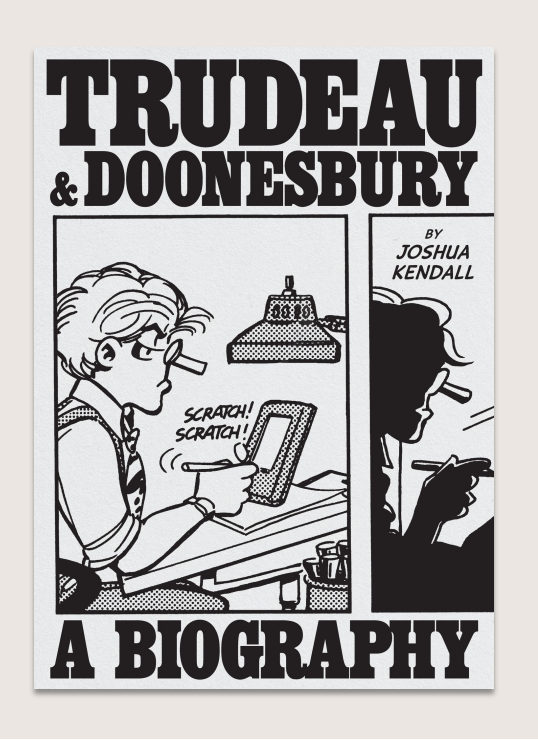
Trudeau & Doonesbury
In Trudeau & Doonesbury, Joshua Kendall introduces Garry Trudeau as a shy, fiercely private cartoonist who transformed a Yale campus strip into an audacious chronicle of American political and cultural life. For more than five decades, Trudeau’s characters have aged alongside their readers while confronting war, presidents, feminism, AIDS, celebrity culture, the internet and the changing fortunes of the baby-boomer generation.
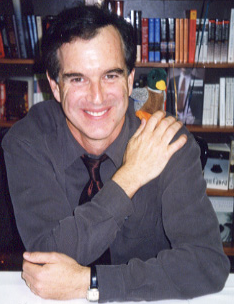
Garry Trudeau, 1999, Wiki Commons.
Our conversation explores how Joshua wrote about a reluctant living subject while preserving his independence and empathetic detachment as a biographer. Trudeau describes the project as unopposed rather than authorised: he gradually cooperated, but neither controlled the manuscript nor read it before publication. Joshua explains how interviews with more than 100 people, together with 200 boxes of Trudeau’s papers at Yale’s Beinecke Library, allowed him to reconstruct the cartoonist’s creative development and test unreliable memories against contemporary evidence.
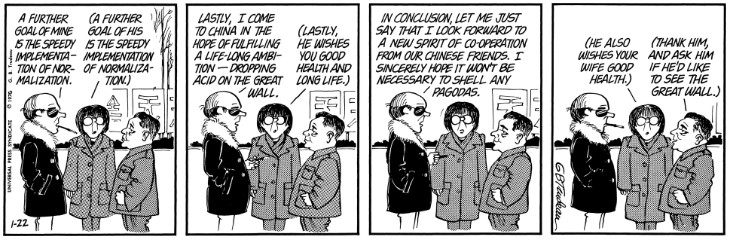
The Doonesbury response to President Ford’s trip to China in 1975.
Joshua reflects candidly on the ethical challenges of portraying someone who is still living, accessing a reticent subject’s inner life and avoiding hagiography. He discusses Trudeau’s early misogynistic humour, his growing self-awareness and the evolution of his portrayal of women, war and trauma. He also reveals how he approached Jane Pauley’s publicly disclosed bipolar disorder with sensitivity and restraint.
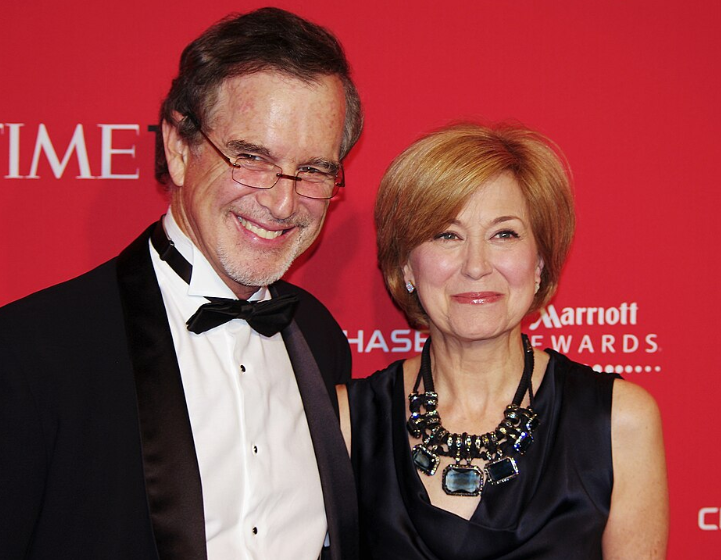
Gary Trudeau and Jane Pauley at the 2012 Time 100 gala.
Photo credit: David Shankbone.
Wiki Commons.
Our conversation illuminates Joshua’s handling of a dual biography encompassing Trudeau, Doonesbury and recent American history. He describes integrating comic strips into the narrative, tracing rough notebook sketches into finished work and finding an ending for a living subject. This compelling exchange presents biography as patient, tenacious archival excavation and as a privileged means of showing how artists grow, reconsider their mistakes and turn the pressures of their times into truly enduring art.
Biographers Wear Multiple Hats
Trudeau & Doonesbury offers a case study in the challenges of writing about an elusive subject who has spent several decades telling the truth about the world while revealing almost nothing about himself. Joshua reveals the most challenging choices biographers face with guarded subjects, including how much to celebrate versus interrogate, how to draw the line between autobiography and invention in a character-based art form and when silence in the record should be honoured rather than filled. It is a useful reminder that the most rigorous life writing often lies in how carefully a biographer marks the edges of what remains unknowable.
Praise for Trudeau & Doonesbury
‘It’s possible Trudeau doesn’t have any skeletons, even plastic ones, in his cupboard . . . Kendall’s book works anyway; it has a good story to tell. I devoured it in two or three sittings, as if it were an ideal bag of popcorn. This book will be a many-sided nostalgia trip for anyone who’s read ‘Doonesbury’ in something like real time, and a mind-popping introduction to Trudeau’s œuvre for tykes who did not.’
—THE NEW YORK TIMES
‘Close to a perfect biography.’
—BOSTON GLOBE
‘A handsome production of a book about a compelling and wildly successful career of writing and art, Trudeau & Doonesbury shows the past six decades of American life through the eyes and imagination of an impressive witness.’
—WALL STREET JOURNAL
‘A long-needed cultural history, the story of how a comic strip influenced political life, and vice versa . . . Plus, it’s a handsome book, full of illustrative strips.’
—CHICAGO TRIBUNE
‘Garry Trudeau, the most perceptive and delightful social satirist of our times, chronicled and defined a generation. In this well-reported and -researched book, Joshua Kendall helps us understand the roots of his humour and insight.’
—WALTER ISAACSON‘
Garry Trudeau, one of the essential voices of his generation, is now the subject of an essential biography. Joshua Kendall tells the story with everything his subject brought to his own comic art: style, wit, passion, intelligence, and deep reporting. No joke: This is a first-rate work, every bit as smart as it is entertaining.’
—JONATHAN EIG, Pulitzer Prize–winning author of King: A Life
Trudeau & Doonesbury Media Coverage
March-April cover story in Yale Alumni Magazine
Review in April-May Smithsonian Magazine
‘It has a good story to tell. I devoured it in two or three sittings.’ NYT review by Dwight Garner
NYT Article where the Cartoonist calls the biography ‘unopposed’
‘Close to a perfect biography.’ Boston Globe Review
Guardian on Trudeau and Doonesbury
A Starred PW Review of ‘a masterful biography’
Kendall piece on Trudeau's Jewish Characters for the Forward
Trudeau's Relationship with Bill Buckley for National Review

Joshua C. Kendall was born in New York City. He received his BA (summa cum laude) from Yale, where he studied comparative literature. An award-winning freelance journalist, he has written on history, politics, biography, health care, and neuroscience for many national magazines and newspapers, including BusinessWeek, Mother Jones, The Nation, Politico, Slate, Time, Wired, The Financial Times, The Los Angeles Times, The New York Times, and The Wall Street Journal. He lives in Boston, where he has ample opportunity to indulge his love of squash. He is currently an associate fellow of Yale’s Trumbull College. His previous books include First Dads, The Man Who Made Lists, and The Forgotten Founding Father.
Episode transcript
Opening Extract
Joshua Kendall
I think we’re storytellers, but there are so many issues that only biographers can really explore, such as how people grow and develop. We’re historians, but what I love about biography is that it has so many elements. In this book, I’m dealing with American history, an art form—the comic strip—and the history of that art form. I’m also dealing with sociological trends, such as the decline of newspapers, which has affected the cartooning and comic-strip industries. There are so few outlets where we can really talk about people’s inner and emotional lives. It’s a special privilege to be able to write biography.
Introduction
Gabriella Kelly-Davies
Hello, I’m Gabriella Kelly-Davies. Welcome to Season 5 of Biographers in Conversation. In each episode, biographers chat about the multiplicity of choices they face while crafting life stories. I’d like to acknowledge Australia’s first storytellers, the Gadigal people of the Eora Nation. The Gadigal people are the traditional owners of the land from which I’m coming to you today. You’ll find us wherever you listen to podcasts and on our website, biographersinconversation.com. Let’s start the show. Garry Trudeau is an American cartoonist best known for creating Doonesbury, the famous political-satire comic strip. A recluse, he spent five decades resisting the biographer’s gaze. So how does a biographer crack open a subject who has spent so long in hiding?
That’s the puzzle at the heart of Joshua Kendall’s Trudeau & Doonesbury: The Cartoonist Who Turned the News into Art. This is the first major biography of the creator of America’s first Pulitzer Prize-winning comic strip. In this episode of Biographers in Conversation, Joshua chats with me about his choices while crafting Trudeau & Doonesbury, a dual biography that traces Garry Trudeau’s life and that of his comic strip.
Gabriella Kelly-Davies
Joshua, welcome to Biographers in Conversation.
Joshua Kendall
It’s a pleasure to be with you, Gabriella.
Who Are Garry Trudeau and Doonesbury?
Gabriella Kelly-Davies
Please introduce us to Garry Trudeau and Doonesbury.
Joshua Kendall
Garry is a baby boomer, born right after the war. He goes to Yale in the mid-1960s, and he writes a comic strip for the Yale Daily News called Bull Tales. And I spoke to the editor of the Yale Daily News in those days, and the Yale Daily News editor said, “Run this comic strip.” And the editor told him, “We print anything.” So that’s how Garry got his start. And the strip took off because Yale in the late 1960s had something that it’s never had before or since, which was an amazing American football team. And the football team had a great quarterback, and it was getting a lot of national attention.
And the strip revolved around the quarterback and the huddle, and it became very popular. So within a couple of weeks of starting that strip, Garry was in the New York Times, and he was off and running. And two years later, when he finished Yale, at about 22, he was a nationally syndicated comic-strip artist. But the strip was initially just about campus humour, about the football team, and about dating. Later, when it became national, he de-Yalified it. He turned it into Walden College.
And then he also decided, gosh, I’m a young person, and there’s a lot happening in this country to young people, and I’m going to talk about sex, drugs and rock and roll, and the war. And that had never been seen on the comics pages. And he sort of revolutionised the comics pages. And he’s been doing the same strip, Doonesbury, from 1970 until today. It was daily and Sunday until 2014. And it’s still on Sunday. So I tell the story of his life. I tell the story of the strip's life. What's interesting is that Charles Schulz, who created Peanuts, was from the Greatest Generation—the generation before Garry—and his characters never age.
Charlie Brown is always about eight years old, even though he’s bald, but he’s always eight years old. And Lucy's always taking the football away. But Garry’s characters age. So it’s the story of Garry and his development as a person. It's the story of his characters. B.D., the football player, ages. Mike Doonesbury, who's the kind of nerdy intellectual, who's kind of a stand-in for Garry, ages. The radical ages. So it’s the story of Doonesbury, Garry, and also it’s the story of American history from the Nixon era through the two Bushes through Trump. And Garry’s chronicling the presidents, but he’s also chronicling the ups and downs of American history. He's talking about culture.
He's talking about the worship of celebrity. He's talking about the AIDS crisis. He's talking about… post-traumatic stress disorder in soldiers when they go to war in Iraq. He's talking about yuppies. He's talking about the rise of the internet. So it’s kind of this, as you say, it’s a dual biography of Trudeau and his strip. But at the same time, it also charts American history as seen through the eyes of a comic-strip artist. And that’s why I called it the cartoonist who turned the news into art because Garry was called in the 1970s an investigative cartoonist. I’ve never heard of that.
And the point I want to make is that he was doing a lot of reporting. He's talking about the Vietnam War. He's talking about Nixon, but he’s also reading a lot and he’s interviewing. And in that, he was original in terms of bringing that to the comics pages. You can see its influence in Stephen Colbert’s work, where there’s sort of this mix of fact and fiction. Before Stephen Colbert did his variety show, he did the Colbert Report, which was kind of a satire, just like Trudeau’s Doonesbury, where he mixes fact and fiction.
The Doonesbury crowd, they meet Henry Kissinger on a park bench in 1971, and so we have these real-life people who pop up in the strip, and Donald Trump has been a fixture of the strip since the late 1980s when he emerged as a nationally famous tycoon for his real estate dealings in New York. He has also been a presidential candidate since the late 1980s. So there are a few different threads, and it was just thrilling. And what made it thrilling was that Garry is very shy, and he doesn’t like to talk about himself.
And he once told me, “I’d really much rather spend an afternoon with my grandchildren than think about what I was thinking about during the Vietnam War.” So he doesn’t really want to write a memoir, but he is fantastic at organising his materials. He is a pack rat—he saved everything. About ten years ago, he donated 200 boxes of material to Yale’s Beinecke Library. It was like going to the candy store every day to look at those materials. There are letters from movie stars, because Garry knew everyone. His wife is Jane Pauley. They’ve been married for forty-five years, and she’s a leading American newscaster.
And they knew everyone, and so there are letters from the Yale files from Robert Redford, and there are letters from… congressmen and the Bush family and Senator John Kerry. So just the paper trail was incredible, plus his original drawings and manuscripts, and Garry even saved his college term papers. So it was just a thrill to do. And again, it’s a multi-layered story.
The Trudeau Archive
Gabriella Kelly-Davies
I’m curious about Garry donating his archive to a library, given his reticence and shyness. Does that suggest he suspected someone would write a biography of him down the track?
Joshua Kendall
He told me the story that he was shocked that they took it, because Garry is so shy. And he said, okay, I called Beinecke, and I said, I have these things. And he figured, well, maybe they’d want the originals of the cartoons, or maybe they’d want the Robert Redford letter. Or maybe they’d want the letter from Barbara Bush or the letter from Henry Kissinger. But he was shocked because the Yale person came and they said, we’ll take it all. Goodness. He's so shy. He cooperated with me, but he didn’t read the book until two months after it was published. And he wrote me an email about a month ago.
He said he finally read the book and, in his typically understated, Garry-esque way, said something like, “I guess I knew a lot of what it was going to contain.” It’s his life, after all. But you get the sense that he never really thought anyone would be that interested in it.
A Biography in Doonesbury?
Gabriella Kelly-Davies
I wonder if your biography of him will end up in Doonesbury.
Joshua Kendall
Well, that would be something. He said he enjoyed reading it. He does put a lot of his friends in Doonesbury: Mike Doonesbury is named after his prep-school friend Charlie Pillsbury, and a couple of his Yale friends also pop up. But he no longer has the daily strip; he’s just doing the Sunday strip. A lot of his current work focuses on Trump, who is a major character. There isn’t as much room for side allusions as there was in the 1970s and 1980s, when he had seven strips a week.
From Sketchbook to Strip
Gabriella Kelly-Davies
It must be hard for him to decide what to focus on now that Doonesbury appears only weekly.
Joshua Kendall
Another fascinating thing was finding his original sketchpads at Yale. I asked Garry about them once, and he said, “Gosh, Josh, I can’t even make sense of them anymore.” But I would look at his strips from 1975 and then at his notebook from 1975, trying to see how the doodles related to a finished strip. Every once in a while, I made a connection. He had a very famous sequence in the early 1980s called In Search of Reagan’s Brain. His reporter, Roland Hedley—who was based on the American television reporter Sam Donaldson—goes inside Reagan’s brain to find out what is in there.
And he goes inside Reagan's brain and tries to find out what’s in there. In the published strip, the sequence was “brought to you by Anacin.” And then I looked at the original notebook and it was brought to you by Ex-Lax, the laxative. And Garry said that, yeah, his editor took that out. But it was cute to see, you know, the story behind the story.
An “Unopposed” Biography
Gabriella Kelly-Davies
The New York Times noted that Garry refers to the biography as “unopposed” rather than “authorised”. How did this distinction shape your role as his biographer?
Joshua Kendall
When I was starting the project, what got me going were the 200 boxes. I said, “Wow, that’s incredible.” Then I wrote to Garry, and he said, “Well, I’m not sure I want to speak with you, but I have those boxes there, and someone should use them.” That was his initial position. Then I started talking to his friends, his college roommates and his college girlfriend. There’s a funny story. His girlfriend in 1968, when the Yale football team was doing well and he was starting Bull Tales, was a student at Radcliffe.
And she paid him the ultimate compliment that she sat on the Yale side at the Yale-Harvard game. But it turned out that she lives a few blocks from me in Boston. So I interviewed her and Garry started getting curious what I was finding. And then he said, okay, I'll talk to you. It wasn’t an authorised biography because Garry has some quirks. I mean, I found I was impressed by Garry. I think there’s a lot of depth and people really like him. But he’s got a few quirks. And one of his quirks is that he’s a control freak. He’s very social, but he also has this independent streak.
And I think that served him well as a cartoonist because he could really enjoy just spending ten hours a day in his studio coming up with his strip. And a lot of people just can’t do that. But he loves the control. He's like building a universe. And he said that to do an authorised biography, it wouldn’t be under his control. And I think that made him really uncomfortable. And so he didn’t really want to see anything that I was writing. He said, you do it. So I wasn’t guaranteed cooperation, but as I got deeper and deeper into the process, he started. And then at one point he said, I want to fact check you.
And I said, sure. But then what happened was I got to know more about what happened in the 1970s than he remembered because I had the Yale files. And he, as an artist, he’s always on to the next thing. And his memory of a certain strip from 1973 is a little fuzzy, and I’ve got the letters and everything. So the fact-checking wasn’t really necessary. But we started emailing, and then eventually I met with him a few times and got a chance to really ask him all kinds of questions. And I think that really helped me shape my portrayal of him.
Following an Archival Clue
Gabriella Kelly-Davies
How did you discover that his former girlfriend lived a few doors away from you?
Joshua Kendall
It’s a funny story because, as a biographer, you’re always searching for more. Beinecke has 200 boxes, but then there’s the question: might there be something somewhere else? So you go to ArchiveGrid and look. I found that there were two Garry Trudeau letters at the Schlesinger Library at Harvard. Why were there two letters? It turned out that a woman who was married to a congressman in the 1970s had written a bestselling book about being a Washington hostess. The Schlesinger Library, which focuses on women’s history at Harvard, held her papers. Among them were two letters from Garry Trudeau.
She had those letters because Garry dated her daughter from 1968 to 1970, and he had written to thank the mother for hosting him at her home. I wondered whether the daughter was still alive. I searched online and found that she lived five blocks from me. We then had lunch and talked about Garry.
Writing About a Living Subject
Gabriella Kelly-Davies
How did you navigate the challenges of writing about a living subject?
Joshua Kendall
I prefer them dead—that’s what everyone says. Garry and I have had some back and forth about this. What’s tough is that Garry is often grouped with other prominent baby-boomer cartoonists, such as Art Spiegelman, who created Maus, and Robert Crumb. Crumb has just been the subject of a terrific biography by Dan Nadel. But I don’t think I could write a Robert Crumb biography. I find him really dark. I think Dan did a good job.
What made this project thinkable for me was that, after speaking to Garry’s friends and looking at the files, I sensed that I could gain access. I didn’t have to deal with anything really messy. With a living subject, that person is in the back of your mind in a way that a dead person isn’t. Fortunately, the ingredients here made it workable for me.
Avoiding Hagiography
Gabriella Kelly-Davies
One challenge when writing about a living subject is the risk that their autobiographical voice will overwhelm your authorial voice. There is also the risk of hagiography as you get to know them. How did you maintain your independence and prevent the book from becoming a hagiography?
Joshua Kendall
The very first day I went to Beinecke, I was excited: “Oh my God, the 200 boxes are coming out!” I started reading some early Doonesbury strips. In the first couple of months, there was a really crude rape joke, and I thought, “Oh my God—do I want to sit with this?” I didn’t want to write a Robert Crumb biography or sit with someone who was really misogynistic. What made me continue with the book was what I learnt from Garry’s girlfriends. I met his first girlfriend in person; that relationship lasted a couple of years.
His second girlfriend, whom I interviewed on the phone, turned out to be a feminist, and she had like suffragists in the family. And she really taught Garry Feminism 101. And what was so moving is that he had this dumb rape joke in 1968, but within a few years, he totally got it. And he had this amazing feminist character, Joanie Caucus. And he was like the darling of the feminist movement. And his coverage of Me Too has been really thoughtful. So I decided to actually show readers that rape joke strip in the book. I wanted to show that when he was twenty years old, he was kind of a jerk.
And to Garry’s credit, he admits it. And when I was doing the launch with him at the 92NY, I said something like, well, Garry, I guess your early strips were somewhat misogynistic. And Garry corrected me. And he said, somewhat? And what I really appreciated about Garry, as I said, he has his quirks. He's a bit of a control freak. And when he was twenty years old, he was kind of misogynistic. But what was really moving is that there’s some sort of self-awareness and some growth. That's something that doesn’t seem to happen enough in this world.
And throughout the book, it was really moving to see his growth because, again, he started it in his junior year at Yale, but the strip, the Yale strip is very sophomoric. You know, there’s a lot of crude humour. And B.D. famously goes to fight in Vietnam because he doesn’t want to do his term paper. So that’s not a very serious critique of the Vietnam War. But what was so moving is thirty-five years later, he sends B.D. to Iraq and B.D. loses his leg. And then Garry does an incredible amount of research on the loss of limbs, on PTSD symptoms. So B.D., the Vietnam warrior, the strips are a bit shallow.
But B.D., the Iraq warrior who gets PTSD, the strips are really, really moving. And again, there’s growth. And Garry himself says, when I was doing the Vietnam stuff, I was 20. And when I was in my mid-50s, it was time for something else. And the self-reflection, I really appreciated. Garry did a strip in 1971 of John Kerry. John Kerry went to St. Paul’s, the same prep school as Garry, and went to Yale. He was four years ahead of Garry, so Garry never knew him personally.
But John Kerry, who later became a senator from Massachusetts and a presidential candidate in 2004, first came to national attention in 1971 when he testified before Congress as a Vietnam vet who was opposed to the war in his famous question about how many more people had to die in the war. And it was very moving. And Garry has a 1971 strip where he kind of makes fun of Kerry as kind of a dumb preppy. And I live in Boston, actually not far from Kerry. And I saw Kerry on the street a couple of years ago. And I told him I was writing the Trudeau book. What did he think about that cartoon?
And he remembered it, of course. And he kind of smiled and said, that was a long time ago. And I’ve forgiven Garry. But when I mentioned it to Garry after the book came out, he said, Josh, I really feel bad about that one because that was kind of a cheap shot. And I really appreciate his self-reflection and his growth. So in terms of hagiography, I think he’s got some issues, like we all have issues. But I was just moved that he thinks about stuff.
At this time in America, there is so much toxic masculinity—without naming names. There are many people saying hateful things about women, becoming embroiled in major Me Too scandals or behaving aggressively. Self-awareness is not what America is known for these days, so it was refreshing to get inside Garry’s head for a couple of years.
Turning the News into Art
Gabriella Kelly-Davies
I’d love you to read the section of the prologue that reveals how Garry portrayed his trip to China with President Ford in his comic strip.
Joshua Kendall
What makes the book, I think, a lot of fun to read is that I integrate the comics into the prose. Garry is an artist, and it’s very hard to convey the art in words. Weaving the comics into the text gives readers a feel for it, and I start doing that in the prologue. The prologue begins in 1975. Garry was born in 1948, and 1975 is an annus mirabilis for him.
He wins the Pulitzer Prize, and he’s young and handsome. He joins the White House Press Corps and goes to China with President Ford. Here’s the text: Trudeau soon worked his Asian excursion into a series of Doonesbury strips that featured his long-running character Duke, modelled on the legendary Rolling Stone journalist Hunter S. Thompson. When George H. W. Bush resigned as ambassador to China at the end of Ford’s visit, Trudeau decided to appoint Duke as his replacement in the fictional world of his strip. Upon his arrival in Beijing, Duke, like his creator, also hoped to create some hipster history atop the Great Wall.
And now I’m reading from the strip. And here's Duke. A further goal of mine is the speedy implementation of normalisation. And then his translator says the same thing. A further goal of his is the speedy implementation of normalisation. Then Duke says, lastly, I come to China in the hope of fulfilling a lifelong ambition, dropping acid on the Great Wall. And he’s speaking to the Chinese official, and the translator says, lastly, he wishes you good health and long life. Okay, the translator is not translating Duke's acid fantasy. And now Duke says, in conclusion, let me just say that I look forward to a new spirit of cooperation from our Chinese friends.
I sincerely hope it won’t be necessary to sell any pagodas. And the translator just simplifies that to, he also wishes your wife good health. And then the Chinese official says, thank him and ask him if he’d like to see the Great Wall. And then my prose continues. Trudeau has long enjoyed skewering celebrities, such as the deliberately outrageous Thompson, who apparently was not amused. That year, the gonzo journalist told a friend, If I ever catch that little bastard, I'll tear his lungs out. By the mid-1970s, Trudeau had officially put his stamp on the American imagination.
As Walter Isaacson, the esteemed biographer who served as editor of Time in the 1990s, tells me, By the time of his trip to China with Ford, Trudeau had already created a totally new genre, the reported comic strip. He then went on to become the poet laureate of our generation. He gave us character types we all knew, such as Mike Doonesbury or Uncle Duke, and he helped to give baby boomers their identity.
Gabriella Kelly-Davies
What is the significance of these passages and this particular comic strip?
Joshua Kendall
I wanted to make the argument that Garry is to baby boomers as Charles Schulz is to the greatest generation. And Garry is a baby boomer, and he’s sort of charting his own journey, which then becomes the journey of fellow baby boomers. I’m about ten years younger than Garry, and I just felt like Garry was speaking to younger people. And again, there'd been nothing like that on the comics page. And right after he wins the Pulitzer, his syndicate obviously was getting a boost in sales and they’d get these calls and various newspapers, all of a sudden they wanted Garry and they were replacing Dick Tracy with Doonesbury.
But there really was nothing like it on the comics pages. And Garry just had a huge influence on the next generation, Bill Watterson and Calvin and Hobbes. But he really is a spokesman, and he didn’t mean to take this on, but that’s what he ended up doing in terms of, through his dogged reporting, just covering the baby boomers and how they grew and developed.
Memory Versus the Archive
Gabriella Kelly-Davies
You interviewed nearly 100 people and studied 200 boxes of Garry’s papers. How did you respond when testimony conflicted—either among interviewees or between their recollections and the archive?
Joshua Kendall
As I get older, what amazes me about biography is what some people can remember and others can’t. Garry was about 75 when I interviewed him and his college friends. Some people in their seventies can remember incidents from their twenties as if they happened yesterday; others have no idea. Garry initially said he wanted to fact-check me, but I trusted the archives much more than his memory, and he often said he simply couldn’t remember. I might talk to someone about an incident that two other people remembered well, while that person didn’t remember it at all. Having the archive was grounding. Without it, the process would have been much more chaotic.
Corroborating Controversies
Gabriella Kelly-Davies
How did you corroborate evidence in the archive?
Joshua Kendall
The archive contains a great many letters. Garry had some strips about Frank Sinatra. He had a famous strip where he emphasises Frank Sinatra's mob connections. The archive had various letters from Frank Sinatra's lawyers. I wasn’t talking about American history per se, but I was talking about the history of Doonesbury. Through the archive, I could just see exactly what happened between the lawyers, and I could see that Frank Sinatra would insult Garry, and he would start his concerts at Madison Square Garden, because Garry was so famous in the 1970s, Sinatra felt like he had to insult Garry.
Sinatra might begin a concert by saying something like, “That Trudeau is a cancer,” and then go on to sing My Way. In any case, the archive told me exactly what the dispute was about and how it was settled. Garry also did some very controversial strips about Dan Quayle, who was vice-president under George H. W. Bush and ran unsuccessfully with him again in 1992. The archive showed me all the research Garry had done. I became excited when I saw a memo marked “confidential”, and I ended up including it in the book. It documented Garry’s research on Quayle.
But I did criticise him there. Garry produced a series of strips claiming that Quayle had taken drugs, but he relied on the testimony of someone who turned out to be a liar. Garry was very unfair to Quayle. The archive showed me what he had and where he had made assumptions based on the memos without having all the evidence. Quayle and his staff complained that the treatment was unfair, and I had to side with Quayle. I wasn’t dealing with major political controversies so much as Doonesbury controversies.
I was dealing with Doonesbury controversies. But it was great to see the archives were really necessary to just anchor everything in facts.
Accessing an Inner Life
Gabriella Kelly-Davies
Given Garry’s shyness and reticence, how did you access his inner life?
Joshua Kendall
That’s very tricky because biographers have to spend a lot of time thinking about what their subject is thinking and feeling. But you can’t say what someone felt unless, for example, he writes in a letter that he was sad about his girlfriend that week. You can’t simply impute thoughts and feelings to a subject, so you have to reveal them through actions. I tried to show how Garry related to other people. I also wanted to show that Garry the person has a good sense of humour, just like Garry the comic-strip artist. It emerged in odd places.
What’s moving is that he can address something as gruesome as B.D.’s PTSD and make it funny. B.D. is screaming one Christmas because he is having nightmares about the war. He tells his wife, “I guess that’s not very Christmassy.” Somehow it’s funny, even though it’s horrifying. One of Garry’s major struggles occurred about twenty years ago, when his wife, Jane Pauley, developed a debilitating case of bipolar disorder. Jane has written about it in a memoir. I spoke to her briefly, but my reporting doesn’t go beyond what she has previously revealed publicly.
But I did ask Garry a little bit about it. And what was so surprising was he kind of had a sense of humour about even the darkest moments. Because one of Jane's symptoms was compulsive shopping. One night, at two in the morning, she bought a home on the internet. Oh, goodness. And I asked Garry about it. And he said that year was really scary. But he had a sense of humour about it. And he said, well, I spoke to her doctor. And he said, it could have been worse. He said, I had another patient who bought an 18th century Irish farmhouse, which had 250 years of back taxes due. Oh, no.
You see that the same sense of humour that enabled him to write about B.D.’s pain also helped him through his own difficult year.
Privacy, Illness and Ethics
Gabriella Kelly-Davies
Your decisions about how you portrayed Jane Pauley’s bipolar disorder illuminate some of the ethical issues biographers face, particularly when writing about living subjects.
Joshua Kendall
I felt that if Jane hadn’t written the memoir, I wouldn’t have wanted to go there. If I’m writing a biography of Garry Trudeau, I don’t know whether it is necessary to discuss problems experienced by other family members. But because she had gone public, I felt it was okay. The major issue for me was how it affected Garry.
Jane has said this before, and I agree: one reason Garry immersed himself in the world of PTSD may be that he had seen his wife’s brain misfiring and wanted to understand how that happens and how people recover. He goes to conferences, writes op-eds and texts psychiatrist friends while researching the subject. Garry pushed back on that interpretation, but Jane has publicly made the connection, and I see it too. That’s another complication when writing about a living subject: you may interpret events differently from your subject.
But I feel that’s my right, provided I do it respectfully. I wouldn’t want to reveal Jane’s condition if she hadn’t made it public. As long as I approach it respectfully, I think I have the right to think differently from my subject.
Ending a Living Life
Gabriella Kelly-Davies
It illuminates the issues around privacy and secrecy and the extent to which, particularly with a living subject, you have to consider whether you might cause harm to the subject or their family. Another difficulty is deciding how to end a biography of someone who is still alive. I’d love you to read the opening passages of the epilogue, titled “Trudeau’s Legacy, Imagined and Real”.
Joshua Kendall
Like his idol, Charles Schulz, Trudeau, who has no plans to stop writing Doonesbury, has already spent more than half a century drawing the same strip. But while the core Peanuts gang—Charlie Brown, Lucy, Linus and Snoopy—never aged, Trudeau’s characters have consistently evolved. However, his artistic medium did force him to set some limits. As Trudeau stated in 2009, “I don’t like the ageing process with the characters any more than I like ageing myself. So I don’t really want to give them all potbellies or have them all lose their hair, if only because you lose some of the iconography, some of the things that so identify the character in people’s minds.”
Moreover, unlike Schulz and most other strip cartoonists, Trudeau has repeatedly addressed death within the confines of his panels. In November 1986, Trudeau killed off his first character, Dick Davenport, the husband of Joanie Caucus’s boss, Congresswoman Lacey Davenport. The obsessive ornithologist dies of a massive coronary immediately after taking a photograph of a Bachman’s warbler, which Trudeau dubs “the Garbo of birds”. In the strip, Dick Davenport is gasping, and the final panel reads, “Immortality”. Trudeau did not make this decision lightly. He told The Washington Post that month that Dick was in his eighties and a minor, although fairly well-known, character.
Trudeau felt compelled to break this new ground when he saw that his friends were beginning to deal with severe illnesses and deaths in their families. He sensed it was something their generation had to come to terms with one way or another. While Dick Davenport died a good death, other Doonesbury characters—notably Andy Lippincott, who died of AIDS in 1990 at the age of 45—were not as fortunate. In 1995, at the age of 47, Trudeau penned a self-obituary in which he envisioned his own good death. He delivered it upon receiving a leadership award from the Coro Foundation.
“Now, I realise this is a risky undertaking,” he stated in his speech that night. “Life is not without its surprises, its bumps, its hairpin turns, its humiliating cul-de-sacs. But at some point in a lifetime, it does become possible to envision a plausible outcome.”
Gabriella Kelly-Davies
Why did you choose this ending?
Joshua Kendall
I was moved because a biography, as all biographers know, gives you a structure of birth, life and death. You have to talk about death. I wanted to give readers a sense of how Garry was thinking about it. The epilogue goes on a little further, and Garry, in his witty way, told me a story about his father and where he would like to be buried. One thinks of Garry as the ultimate urban sophisticate.
He went to Yale, lived in Manhattan for many years, but he’s actually a country boy who played with guns as a kid, and he grew up in Saranac Lake in the Adirondack Mountains. And his father was the town doctor. There's a church, a kind of fancy church, where his great-grandfather, who's a doctor, and his grandfather were buried. And Garry’s father said, Garry, I don’t want to be buried in the fancy church. I want to be buried in the simple church because that’s where my patients are buried. And I don’t like those. Those people are all snobby. I don’t like the snobs.
And Garry, in his own witty way, told me, he said, I told my father, Dad, you'll be dead. You know, you won’t care, but you need to be near your family. And Garry has decided that he wants to be buried near the snobs, not because he likes them, but because that’s where his family is buried.
What I find moving about Garry is that he comes from wealth and privilege, but also from a time—this is sad in America—when people such as Franklin Roosevelt felt a duty to police their own: to say, “I have a lot of good fortune, and my job is to make this country great for everyone, not just my people.” Garry is very critical of presidents and American culture, and he’s critical of the snobs.
But that’s where his family, that’s where his dad is, and he wants to be next to his dad. But again, that’s a natural ending for every biography.
Advice for Biographers
Gabriella Kelly-Davies
What advice would you offer other biographers who are writing about a living subject?
Joshua Kendall
It’s very complicated, and I would encourage biographers to think carefully about it. Whether the subject is living or dead, you have to live with that person in your head for a couple of years. It’s much tougher if a living subject carries a lot of darkness. I joked with Garry that I prefer my subjects dead. You have to go through a long checklist to make sure you want to undertake the project. This one worked because I felt Garry had normal character flaws; he didn’t have anything that shook me to the core.
Robert Crumb is a great artist, but some of his baggage really shakes me up. It might not shake someone else, but you have to think about what you can handle because the work is intense and presents a whole set of challenges. Everyone must make their own decision, but they should think it through carefully and consider the steps they will need to take. It’s a much more complicated ballgame than writing about a nice dead subject.
The Biographer’s Role
Gabriella Kelly-Davies
Just in closing, what do you believe is the role of a biographer?
Joshua Kendall
I think we’re storytellers, but we have special stories to tell. We’ve talked about growth: there are so many issues that only biographers can really explore, such as how people grow and develop. We’re historians, but what I love about biography is that it has so many elements. In this book, I’m dealing with American history, an art form—the comic strip—and the history of that art form. I’m also dealing with sociological trends, such as the decline of newspapers, which has affected the cartooning and comic-strip industries. There are so few outlets where we can really talk about people’s inner and emotional lives. It’s incredibly challenging because there’s so much to deal with, but it’s a special privilege to write biography. English departments don’t like us and history departments don’t like us, but we have special knowledge that I think the public appreciates much more than academics do.
Closing Reflections
Gabriella Kelly-Davies
Joshua, I could keep talking to you forever, but I know it’s very late at night for you in Boston, so we should bring our conversation to an end. Thank you for chatting with us about Trudeau & Doonesbury. What emerges from our conversation is a portrait of biography as a patient, tenacious excavation. You spent two years building trust with a subject who, decades earlier, hid in a bathroom for four hours rather than face a reporter. Your insistence on an “unopposed” rather than authorised biography preserved your independence, even as email exchanges gradually revealed Garry’s guarded wit. Trudeau & Doonesbury is a case study in the ethics and limits of writing about the living. It suggests that reticence itself, carefully read, is its own kind of revelation. Thank you.
Joshua Kendall
It’s been a pleasure.
Credits
Gabriella Kelly-Davies
Thank you for listening to Biographers in Conversation. Special thanks to my producer, Andy Marr; web manager, Dylan Hamilton Foster; and Sonny Narderdale for the music. We’d love you to take a moment to rate the show on the website, across social media, on Apple Podcasts or Spotify, or wherever you find your podcasts. If you enjoyed this conversation, please share it with your family and friends and on social media. To discover more about my guests and their biographies, head to their show pages on biographersinconversation.com. There you’ll find all our episodes and ways to get in touch with us. I’m looking forward to our next conversation about the choices every biographer faces. I hope you are too.