





In 1975, Australian Prime Minister Gough Whitlam poured a handful of red earth into the hands of Gurindji elder Vincent Lingiari at Wattie Creek in the Northern Territory, an event that heralded a new era of Indigenous self-determination. The moment was captured in a now iconic photograph taken by Mervyn Bishop, a Murri man from Brewarrina who, at just 17, walked into the Sydney Morning Herald newspaper as Australia’s first Indigenous press photographer. He spent the next six decades quietly reshaping how Australia sees itself.
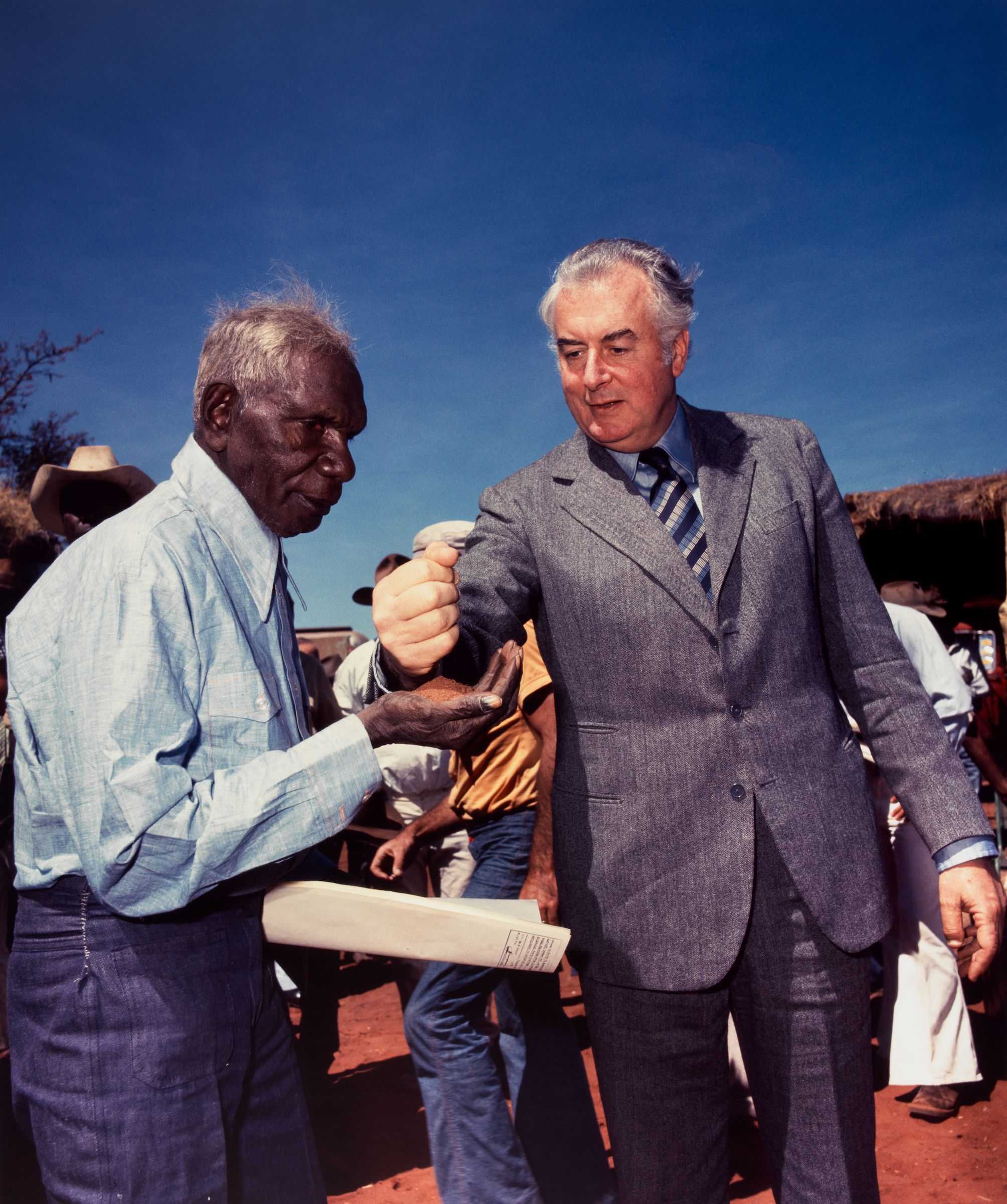
Prime Minister Gough Whitlam pours soil into the hand of traditional landowner Vincent Lingiari, 1975.
Wiki Commons.
Black, White + Colour
Mervyn Bishop is often celebrated for chronicling the rising visibility of Indigenous Australians. He carved his own path, deftly navigating the Black and White worlds of post-war Australia. In this latest episode of Biographers in Conversation, Tim Dobbyn, a journalist and lifelong friend of Mervyn Bishop, chats with me about Black, White + Colour: A Biography of Mervyn Bishop, Australia’s First Indigenous Professional Photographer.
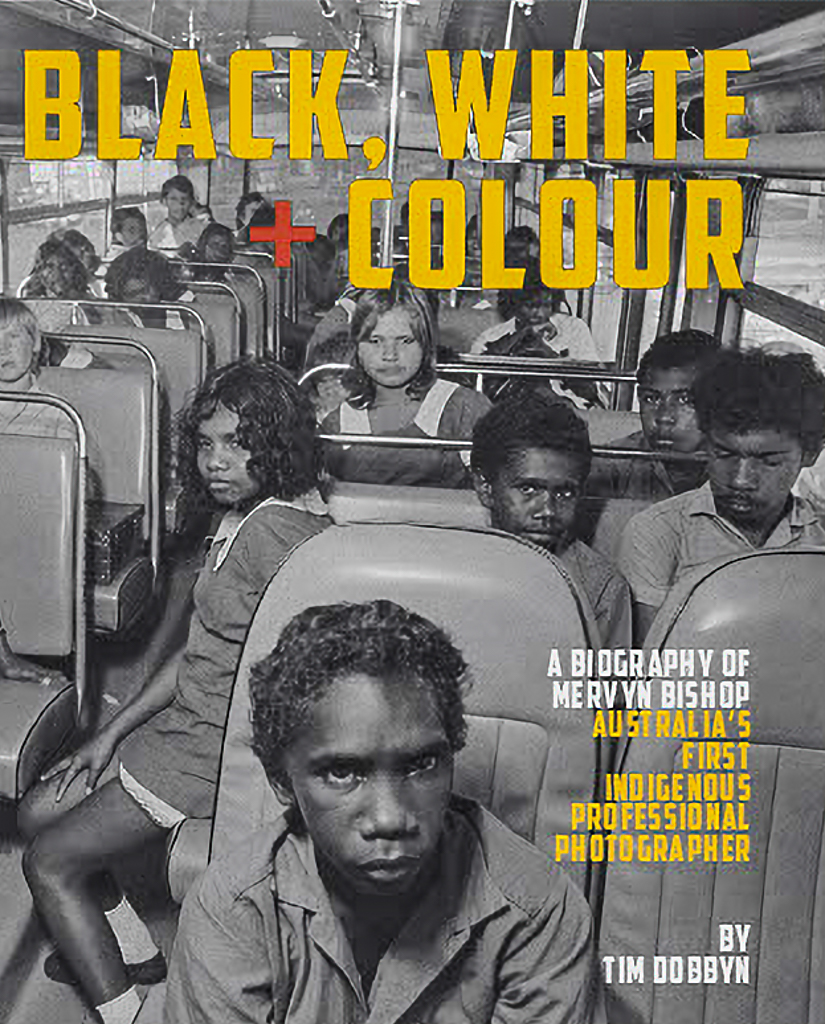
In 1962, Tim Dobbyn’s family met Mervyn Bishop in Dubbo. What began as a childhood acquaintance with his parents’ friend deepened into a lifelong friendship, eventually becoming a nine-year biographical project. Tim explains the unique challenge of writing about a living subject he has known so intimately, describing how his background in journalism helped him maintain rigour, corroborate stories and gently push back against Mervyn’s occasional self-mythologising.
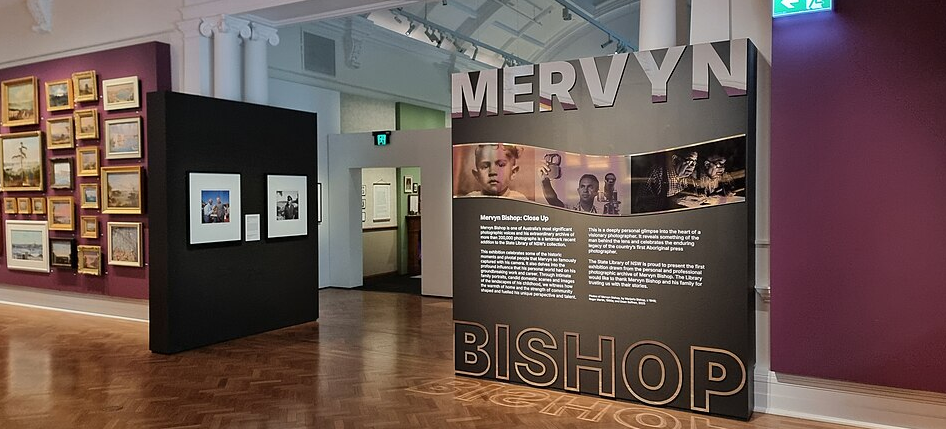
Mervyn Bishop exhibition, State Library of New South Wales, October 2025,
by Geoffrey Barker, Creative Commons.
Our conversation traces Mervyn’s extraordinary career, from documenting 1960s Sydney and navigating a newsroom where casual racism coexisted with genuine affection, to his years at the Department of Aboriginal Affairs developing an ethical, humour-driven approach to photographing people in difficult circumstances. Tim also explores the early influence of Mervyn’s mother Marjorie and the devastating impact of the death of Elizabeth, his beloved wife.
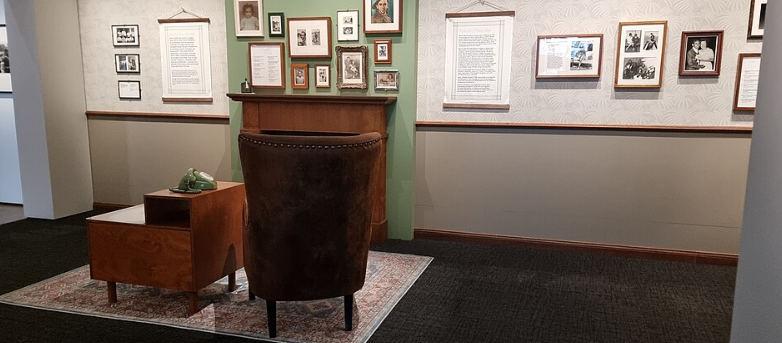
Gary Trudeau and Jane Pauley at the 2012 Time 100 gala.
Photo credit: David Shankbone.
Wiki Commons.
Mervyn Bishop once said he wanted to do the best work he could, not the most political or celebrated work, but simply the best. And yet, in pursuing that quiet personal standard, he produced images that altered the way a nation understood itself.
Black, White + Colour honours the complexity of Mervyn’s life as a First Nations photographer succeeding in a white world despite the immense challenges he faced. It reminds us that to reduce Mervyn Bishop to a single photograph, however extraordinary, is to miss the larger story of a life spent navigating two worlds with charm, craft and uncommon grace. Black, White + Colour resists reducing Mervyn Bishop to a single famous image, instead capturing a life of quiet craftsmanship spent navigating two worlds with charm and grace.
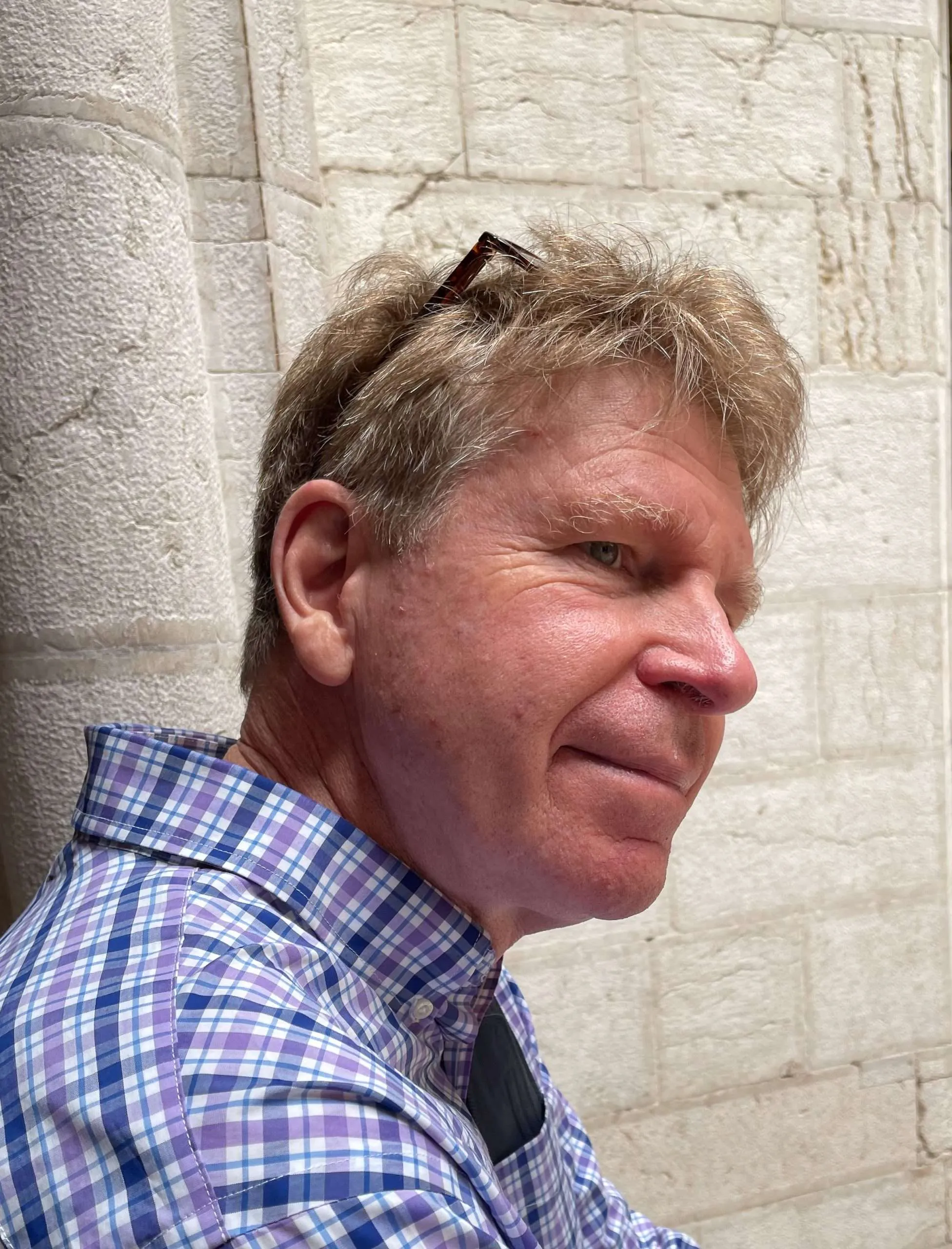
Tim Dobbyn is a former journalist. He started at Australian Associated Press in 1981 before moving to the United States in 1987 to work for Reuters until 2014. After taking a break from daily journalism, he worked freelance before embarking on the Mervyn Bishop biography project in 2018. He and his family have known Mervyn Bishop since 1962.
Episode transcript
Opening extract
Tim Dobbyn
I wanted people internationally to appreciate what Australia has been wrestling with for decades, really: what is the history of Australia? As I say in the book, there’s one version of intrepid white explorers and settlers fanning out across an empty continent. On the other hand—and probably much closer to the truth—it was a murderous land grab in a country that was much more densely settled than the British authorities had expected. I made a nod to the alternative view, but when you look at explorers’ logbooks—and I footnoted some of that material—it’s clear there were many more people here and quite large settlements in various places.
Introduction
Gabriella Kelly-Davies
Hello, I’m Gabriella Kelly-Davies. Welcome to Season 5 of Biographers in Conversation. In each episode, biographers chat about the multiplicity of choices they face while crafting life stories. I’d like to acknowledge Australia’s first storytellers, the Gadigal people of the Eora Nation. The Gadigal people are the traditional owners of the land from which I’m coming to you today. Aboriginal and Torres Strait Islander listeners are advised that this conversation contains information about people who have died. You’ll find us wherever you listen to your podcasts and on our website, biographersinconversation.com. Let’s start the show.
In 1975, many Australians saw a historic photograph of Australian Prime Minister Gough Whitlam at Wattie Creek in the Northern Territory. He was pouring a handful of red earth into the hands of Gurindji elder Vincent Lingiari. However, few knew the identity of the photographer. This iconic image belongs to Mervyn Bishop, a Murri man who, at just 17, walked into The Sydney Morning Herald as Australia’s first Indigenous press photographer. He spent the next six decades quietly reshaping how Australia sees itself. Mervyn Bishop is often celebrated for chronicling the rising visibility of First Nations Australians. He carved his own path, deftly navigating the black and white worlds of postwar Australia. In this latest episode of Biographers in Conversation, Tim Dobbyn, a journalist and Mervyn’s lifelong friend, chats with me about Black, White + Colour, a biography of Mervyn Bishop, Australia’s first Indigenous professional photographer.
Gabriella Kelly-Davies
Tim, welcome to Biographers in Conversation.
Tim Dobbyn
Thank you for having me. It’s great to be here.
Mervyn Bishop and the biography
Gabriella Kelly-Davies
Please introduce us to Mervyn Bishop and your biography of him.
Tim Dobbyn
I think Mervyn Bishop is a unique figure in a couple of ways. Joining a major newspaper as an Aboriginal man—really, no more than a boy at 17—was an incredible achievement. But he also went on to take many splendid photographs, including the iconic one you’ve just mentioned.
Tim Dobbyn
The biography tries to place his life in the context of the times. He was born in 1945, which was an important watershed. The state governments that still had control over Aboriginal people were pushing for assimilation, and his parents seem to have seized the opportunities it offered with both hands—sometimes at the expense of his knowledge of Aboriginal ways. He acknowledges that and says he later reclaimed that knowledge through his photographs.
Tim Dobbyn
I think the book offers a nice balance of text and wonderful photographs. We both come from a journalistic tradition, so it moves along at a good pace. I think it’s a reasonable tale.
Gabriella Kelly-Davies
It is a remarkable tale. I thought the book was excellent.
From family friend to biographer
Gabriella Kelly-Davies
Your family has known Mervyn since 1962. At what point did your deep friendship with him become a biographical project?
Tim Dobbyn
For much of my life, he was really my parents’ friend. He’s between my parents and me in age, and my parents were responsible for meeting him in 1962. We drove to Dubbo on our way back from Mildura to Sydney and dropped in on Mervyn, who was going to high school there.
Tim Dobbyn
During repeated visits to Australia with my family, I always saw Mervyn and another kind of friendship developed. He was no longer simply an uncle-like figure to have around; I was genuinely interested in him as a person. Through the book, of course, we’ve become fast friends. We talk once a week, whether there’s really anything to talk about or not.
Gabriella Kelly-Davies
How old is he now?
Tim Dobbyn
Mervyn’s 81. He’s in reasonable health. He played a practice round of golf the other day, and that’s one of his favourite pastimes, which the book mentions a couple of times in humorous ways.
Gabriella Kelly-Davies
Is he still living in Dubbo?
Tim Dobbyn
Yes. He lived in Sydney for the longest time, and I think that, if the cards had fallen the right way, he’d still be there because he finds Sydney incredibly stimulating and has lots of friends there.
Tim Dobbyn
But Dubbo is also very familiar to him. He went to high school there. His sister lives there, and his daughter lives there with her family. Many people from Brewarrina, his hometown, now live in Dubbo. It’s bigger, and there are more jobs and services. A lot of people from ‘Bre’ live in Dubbo these days.
Gabriella Kelly-Davies
Is photography still a career for him, or is it now a hobby?
Tim Dobbyn
It’s a hobby. He mainly works with his mobile phone and occasionally brings out his larger camera. It’s mostly for family events, although sometimes something interests him and he’ll take his camera along. For the most part, his career as a professional photographer ceased about six years ago, just before the pandemic.
A documentary eye
Gabriella Kelly-Davies
What is distinctive about his photography?
Tim Dobbyn
What distinguishes his photography is that it’s very straightforward. It has a documentary style. He will ask people to do certain things—to demonstrate things—but it isn’t art photography. That created a tension in the later part of his career: he was adopted by the art world, but that isn’t the language he speaks.
Tim Dobbyn
He has really stuck to his guns, with the exception of one or two works that have caused great excitement, such as his quartet of Bungaree images, in which his son dressed as different facets of Bungaree. Bungaree was an Aboriginal man in the early Sydney colony who was sometimes dressed in British uniforms and other clothing he’d been given, but at other times returned to his people at Broken Bay and participated in corroborees.
Tim Dobbyn
In a funny way, Mervyn identifies with Bungaree because he, too, belongs to both worlds. He has always been equally comfortable in the bush, talking to a small community, and at an art-gallery opening with 300 people. That has served him well in life.
Tim Dobbyn
His ability to relate to people was evident very early in his childhood, and it comes through in his photographs. Portraiture is probably his strongest suit. His is a sympathetic form of portraiture: he tries to capture the essence of the person—something that makes the subject say, ‘Yes, that’s me,’ while other people looking at the image think, ‘Yes, you captured something there. You got them.’
Friendship and authorial distance
Gabriella Kelly-Davies
How did you navigate the tension between your personal closeness as a friend and authorial distance?
Tim Dobbyn
I was very conscious of that, but I think the friendship was actually an advantage. I had a career in journalism, so I knew the standards I needed to uphold. If someone else had written the book, they might have been a little too reverential towards the great photographer and might not have delved into his personal life as much as I did. He might not have opened up as much to someone who hadn’t known him for a long time.
Tim Dobbyn
I hear it’s quite a unique situation—a biographer knowing someone for that long and then writing about them. I’m told there’s one exception, but I forget whether the author or the subject turned out to be a serial killer. I assure you that isn’t the case here.
Gabriella Kelly-Davies
I’m very glad.
The path to publication
Gabriella Kelly-Davies
The biography took nine years to complete. What were the greatest challenges and obstacles?
Tim Dobbyn
One of the things I learned is that writing a book is, in some ways, the easiest part. Most of the writing was done during the pandemic. When Australia was in lockdown, I knew where people were: at home and available for interviews.
Tim Dobbyn
The hardest part was finding a publisher as a first-time author. I was extremely fortunate with Ginninderra Press. I caught them at the right moment. The State Library had just announced a year-long-plus exhibition of Mervyn’s photographs, and I think the publisher was willing to accept the book as a kind of turnkey project.
Tim Dobbyn
I’d become so fed up with the publishing industry. I was told that no one cared about Australian artists; that there were plenty of stories about Aboriginal people; and that, as a white person, I shouldn’t write about this subject. All sorts of obstacles were thrown up.
Tim Dobbyn
So I had the book designed by a very good British designer who had previously worked for Thames & Hudson. It was ready to go. Ginninderra Press looked it over and said, ‘This is a nice book. Let’s do it.’
Gabriella Kelly-Davies
What advice would you give other writers who are having similar trouble getting their books published? Are there lessons you would follow if you wrote another book?
Tim Dobbyn
Another book? That’s daunting. But I think persistence is important. You knock on a lot of doors, but you also have to look for the publisher who may be searching for your book to round out their portfolio.
Tim Dobbyn
We also have to be honest: given the state of the book industry, first-time authors often pay substantial production costs. I paid for the printing, for instance, so you have to keep those things in mind. My book was unusual because I wanted high-quality photographs to accompany the text. That increased the production costs and, I think, put some publishers off. If it’s a print-on-demand book with lots of words and few or no illustrations, the situation changes.
Gabriella Kelly-Davies
Timing was the perfect solution in your case, wasn’t it? There was an element of serendipity.
Tim Dobbyn
There certainly was. Mervyn became impatient towards the end and said, ‘When is this book coming out? Why don’t you just self-publish it?’ I said I could do that—and would if push came to shove—but it was so much better to have an imprint behind it.
Tim Dobbyn
He said, ‘Well, get it out while we’re both the right side of the grass.’ We both had health challenges during the writing, and several people I interviewed also departed the building. It was very fortunate that the State Library announced the exhibition. I’m glad they did.
Truth, memory and self-mythology
Gabriella Kelly-Davies
You’ve described Mervyn as a craftsman who wanted to do the very best work. His career was interwoven with Indigenous Australia, even though he never sought to capitalise on that. He had a strong autobiographical voice and did self-mythologise. How did you respond to those mythologies, and did you challenge them?
Tim Dobbyn
His career covers an extraordinary breadth of time and place. Early at the Herald, for instance, he took wonderful photographs that captured Sydney in the 1960s. Then he went to the Department of Aboriginal Affairs and took those wonderful photographs.
Tim Dobbyn
But when I did the road trip with him, which occupies the book’s first chapter, he would sometimes embellish things slightly. We were in Nyngan, I think, and he pointed to a sign that said ‘Mervyn’s Walk’. He said, ‘How about that? Isn’t that great?’ I read it and said, ‘Hang on a minute—that’s a different Mervyn.’ He said, ‘Oh yes, but it would be good in the book, wouldn’t it?’ I said, ‘No, it would not be good in the book.’
Tim Dobbyn
I trained him early on that I wasn’t going down that path. The book would include the good and the bad, but it would be truthful. Some people have said the book is courageous in the way it touches on negative things in his life, but he accepts it all. His children read it before publication and were fine with it.
Tim Dobbyn
There was tragedy. After his wife died on the day of his first solo exhibition, he struggled to be a good solo parent. His daughter eventually went to Dubbo to live with Mervyn’s mother and sister. His son, Tim, was in high school and went off the rails for a few years, as he admits in the book.
Tim Dobbyn
Elizabeth’s death was disastrous because she was the organising force who kept the trains running on time. Had she still been alive when Mervyn found new fame as an art photographer, I think she would have shepherded that in some way. But he was lost. As William Yang, another well-known Australian photographer, says in the book, without Elizabeth, Mervyn was lost. He needed an organiser, and she was no longer there.
Gabriella Kelly-Davies
She was a lovely person.
Tim Dobbyn
Lovely. It’s very, very sad.
Marjorie Bishop and photography
Gabriella Kelly-Davies
Mervyn’s mother, Marjorie, was a keen photographer herself and recognised Mervyn’s talent early. How did you portray her and the role she played in her son’s life and career?
Tim Dobbyn
Most accounts of his life refer to his mother’s interest in photography, and it’s certainly true. As a child, you see something your parents are interested in and want to have a go yourself. She was a very good photographer. I included a fabulous photograph she took of a wool truck being loaded, with two little children and dogs at their feet. She had an eye, and clearly he inherited something from her.
Tim Dobbyn
I’m not sure that she—or even Mervyn—realised photography would become a career. For them, it was simply a wonderful hobby. It’s perhaps not well known among white Australians, but Aboriginal people loved photography. It was a powerful way to create a record of the family when so many people were trying to tear families apart.
Tim Dobbyn
People submitted photographs to the magazine published by the New South Wales Department of Aboriginal Affairs as a subtle way of contacting children who had been taken away. The children could see their families and where they were living. Photography was a powerful thing.
The Herald newsroom
Gabriella Kelly-Davies
Mervyn joined The Sydney Morning Herald in the early 1960s. He was the first Indigenous person to work on a metropolitan daily newspaper. How did you represent his colleagues’ attitudes towards him and the atmosphere in the newsroom?
Tim Dobbyn
I spoke to his colleagues and reported their comments very directly, but some of those comments were telling. Clearly, everyone loved him, yet they couldn’t resist telling the odd racist joke.
Tim Dobbyn
When he returned to the Herald—a difficult period in his career—one person said in the book that Mervyn ‘had a bit of a walkabout thing’ when he came back from Canberra. You think, ‘Hmm, okay.’ The same person said, ‘We never thought of him as Aboriginal. We just all went to the pub after work.’ But clearly he was different. I was able to let those comments and incidents speak for themselves.
Tim Dobbyn
There’s a scene at a restaurant where the manager called the police because a waitress’s handbag had gone missing. The police were waiting for the Herald photographers when they came out onto George Street because, as one of his colleagues put it, the first person they suspected was ‘Merv, the black bloke’. It was outrageous. Then the manager came down and said the waitress had found her handbag; she had misplaced it.
Tim Dobbyn
He encountered that sort of thing several times. But, as he has told me, he has always played things right down the middle. He has felt mistreated at times by both whitefellas and blackfellas. I think he struggled with his identity over the years, but later in life, as I say in the book, he came to accept all of it.
Tim Dobbyn
His father was half Punjabi Indian. As was typical in north-western New South Wales, there were also fathers of Irish and British origin in the family line. He embraces all of it now.
Recognition without advancement
Gabriella Kelly-Davies
In 1971, Mervyn won the Nikon–Walkley Australian Press Photographer of the Year Award, but he didn’t receive the customary pay rise that came with the award. How did you interpret his employer’s response?
Tim Dobbyn
Looking at the evidence, there was certainly spite on the part of the manager at the time, probably tinged with racism. But Mervyn never says that. He says, ‘I just don’t know.’
Tim Dobbyn
Before the award, there was an incident in the news photography department when the manager was giving advice—whether to Mervyn specifically or to young photography cadets in general isn’t clear. He said, ‘Look, you’ve just got to get a toehold in Sydney real estate, even if you only buy a block of land.’ Mervyn quipped, ‘My people once had a lot of land.’ Everyone laughed, but it made the manager feel very small. The story travelled through the newsroom; a journalist told me he had heard it within a day.
Tim Dobbyn
There seems to have been mutual antipathy between the two men. But it is extraordinary that Mervyn never rose above C grade. The grades were A, B, C and D. After your cadetship, you became a D-grade photographer, then moved to C grade and upwards. Despite years at the Herald and winning the award, Mervyn never advanced beyond C grade.
Tim Dobbyn
That was really why he moved to Canberra, partly at his wife’s insistence. She thought the situation was hopeless and that his boss was racist. Mervyn thought there was more to it than that: the two men simply didn’t get on.
Elizabeth Bishop’s influence
Gabriella Kelly-Davies
Three years after he won the award, Elizabeth encouraged him to join the Department of Aboriginal Affairs in Canberra. How much of the biography’s arc is Elizabeth’s story, given her influence on his life?
Tim Dobbyn
Elizabeth’s influence is enormous. Not only was it significant while she was alive, but her absence after her death was felt so acutely that it altered the trajectory of Mervyn and the family.
Tim Dobbyn
Unfortunately, there are only two photographs of her in the book, both taken on their wedding day. She was a lovely person and she really didn’t seem to see colour.
Tim Dobbyn
There’s a funny incident. She told Mervyn, ‘My mother and my new stepfather are in town. They’re staying at this hotel. Why don’t you call them and arrange to have a drink after work? Introduce yourself.’ Mervyn arrived at their hotel room, and Elizabeth clearly hadn’t told her mother that he was an Aboriginal man—it was a kind of Guess Who’s Coming to Dinner moment. Her mother recoiled, apparently, but her second husband, whom I knew, was a stock and station agent who had worked in the bush with many Aboriginal people. He was very open and welcoming.
Tim Dobbyn
There was some tension, especially early on. But once Mervyn won the photography award, his mother-in-law was very proud of him.
An ethical photographic practice
Gabriella Kelly-Davies
During his time at the department, Mervyn developed a practice of photographing people in dire circumstances while also knowing when not to raise the camera. How did he articulate this ethical code to you, and how did you represent it?
Tim Dobbyn
I gave an example in the book of how he would ask people, ‘Do you mind if I take some photographs?’ Sometimes they initially said, ‘No, no photos.’ He would reply, ‘That’s all right. I’ll still get paid.’ But then he might add, ‘I could help you get something you need—new housing, perhaps.’
Tim Dobbyn
He had other ways of putting people at ease. He would carry more than one camera, give one to a child and say, ‘Take some pictures of me.’ He loosened people up with humour. That’s Mervyn all over: empathy and humanity. He soon had people eating out of his hand.
Tim Dobbyn
After my father’s eightieth birthday party, for example, Mervyn gathered the immediate family for a photograph. My sister’s mother-in-law was there—a fearsome 90-year-old white matriarch. He said, ‘Come on, Auntie, come and get in the photo.’ She replied, ‘I am not your auntie.’ She thought he was being impertinent.
Tim Dobbyn
He explained, ‘Look, where I’m from, “Auntie” is a term for a respected older person. Now come and let me take a photograph of your beautiful face.’ He had her eating out of his hand. She told that story for the next ten years, until she died aged 100.
Tim Dobbyn
He disarms people and has always used humour. As Hetti Perkins and others say in the book, his photographs aren’t overly aggressive. He insinuates himself into a situation and represents the scene, but he isn’t looking to exaggerate or sugar-coat it.
Writing about a living subject
Gabriella Kelly-Davies
How did you navigate the challenges of writing about a living subject?
Tim Dobbyn
That question came up recently at an event in Melbourne where the former curator of photography at the National Gallery of Australia spoke. She argued that it’s better for biographies to be written while the subjects are alive. I have a friend here in America who specialises in writing about dead people. He always adds parenthetically, ‘They can’t contradict you.’
Tim Dobbyn
I think writing about Mervyn while he was alive worked well. Had I written the book much earlier, he would still have been in his active working life. I caught him towards the end, when he was willing to reflect. It’s wonderful to have his voice in the book and to hear him telling these stories.
Tim Dobbyn
But the book isn’t a memoir or an ‘as told to Tim Dobbyn’. It involved investigation and finding out what other people thought.
Gabriella Kelly-Davies
Many biographers steer clear of living subjects. They prefer safely dead subjects, as you say. I wrote a biography of a living subject, and there were many positive aspects, although you must remain detached and independent, interpret the evidence for yourself and corroborate it.
Gabriella Kelly-Davies
Really, you need corroboration from two or more witnesses for anything you put in the book, because memory is fickle. We need to be cautious, particularly with living subjects: they tend to have strong autobiographical voices; they self-mythologise; and many try to influence the biographer to tell the story they want told rather than the story the biographer wants to write. Those are some of the disadvantages, but there are many positives.
Tim Dobbyn
As I’ve said, I was aware of Mervyn’s efforts to steer things occasionally. Luckily, he loves to talk and talk, and sometimes I caught him contradicting himself. I would ask, ‘Okay, which is it?’
Tim Dobbyn
I was also able to use contemporary news accounts to settle certain questions and to look at photographs other people had taken of the same event. There were many ways to triangulate and get as close to the truth as possible.
Tim Dobbyn
I’m very happy with the book. I probably short-changed the art period in Australia during the 1990s, but I did that to create a book that a reasonably intelligent person would enjoy. I didn’t include as much detail about that period as some people who were there would have liked. I received feedback that I’d left out this or that, but I still think I captured him. I didn’t want to bog the book down.
Tim Dobbyn
I wanted people to be able to read it and appreciate not only his life but also the context in which these events took place, whether the Olympic Games or the Bicentenary celebrations.
Placing a life in history
Gabriella Kelly-Davies
How did you represent the historical, political, cultural and social context of his life?
Tim Dobbyn
In a way, it was an education for me because I knew the scant history we’d learnt at school was probably rubbish, frankly. I read deeply. I read a substantial book about the First Australians by a Monash academic, although I’m trying to remember the author. There’s also a very good book by Nigel Parbury, ostensibly about New South Wales but covering much more ground. I read Jimmie Barker’s life story—he was another Brewarrina resident—and really began to get a feel for the history.
Tim Dobbyn
I was away from Australia during the apology period, but I read about what had happened in Parliament under John Howard, whom I knew something about because he lived next door to a very good friend of mine from primary school. I also used to see him in the press gallery. Howard declined to make an apology as such—he came close, but he didn’t—and then Kevin Rudd delivered the apology.
Tim Dobbyn
I wanted people internationally to appreciate what Australia has been wrestling with for decades, really: what is the history of Australia? As I say in the book, there’s one version of intrepid white explorers and settlers fanning out across an empty continent. On the other hand—and probably much closer to the truth—it was a murderous land grab in a country that was much more densely settled than the British authorities had expected.
Tim Dobbyn
I made a nod to the alternative view, but when you look at explorers’ logbooks—and I footnoted some of that material—it’s clear there were many more people here and quite large settlements in various places. We’re still reckoning with that, as we saw in the vote a couple of years ago and the negative response to it.
Conclusion
Gabriella Kelly-Davies
Tim, thank you for introducing us to Mervyn Bishop.
Gabriella Kelly-Davies
Mervyn once said that he wanted to do the best work he could—not the most political work, not the most celebrated work, but simply the best. Yet, in pursuing that quiet personal standard, he produced images that altered the way a nation understood itself.
Gabriella Kelly-Davies
Your biography honours the complexity of Mervyn’s life as a First Nations man succeeding in a white world despite the immense challenges he faced. It reminds us that to reduce Mervyn to a single photograph, however extraordinary, is to miss the larger story of a life spent navigating two worlds with charm, craft and uncommon grace. Thank you so much.
Tim Dobbyn
You’re most welcome. I’ve enjoyed our conversation.
Credits
Gabriella Kelly-Davies
Thank you for listening to Biographers in Conversation. Special thanks to my producer, Andy Marr; web manager, Dylan Hamilton-Foster; and Sonny Nardidale for the music.
Gabriella Kelly-Davies
We’d love you to take a moment to rate the show on the website, across social media, on Apple Podcasts or Spotify, or wherever you find your podcasts. If you enjoyed this conversation, please share it with your family and friends and on social media.
Gabriella Kelly-Davies
To discover more about my guests and their biographies, head to their show pages at biographersinconversation.com. There you’ll find all our episodes and ways of getting in touch with us.
Gabriella Kelly-Davies
I’m looking forward to our next conversation about the choices every biographer faces. I hope you are too.