





In this episode of Biographers in Conversation, the historian, ethicist and author, Dr Nigel Cameron, chats with Dr Gabriella Kelly-Davies about his choices while researching and writing: Dr. Koop: The Many Lives of the Surgeon General.
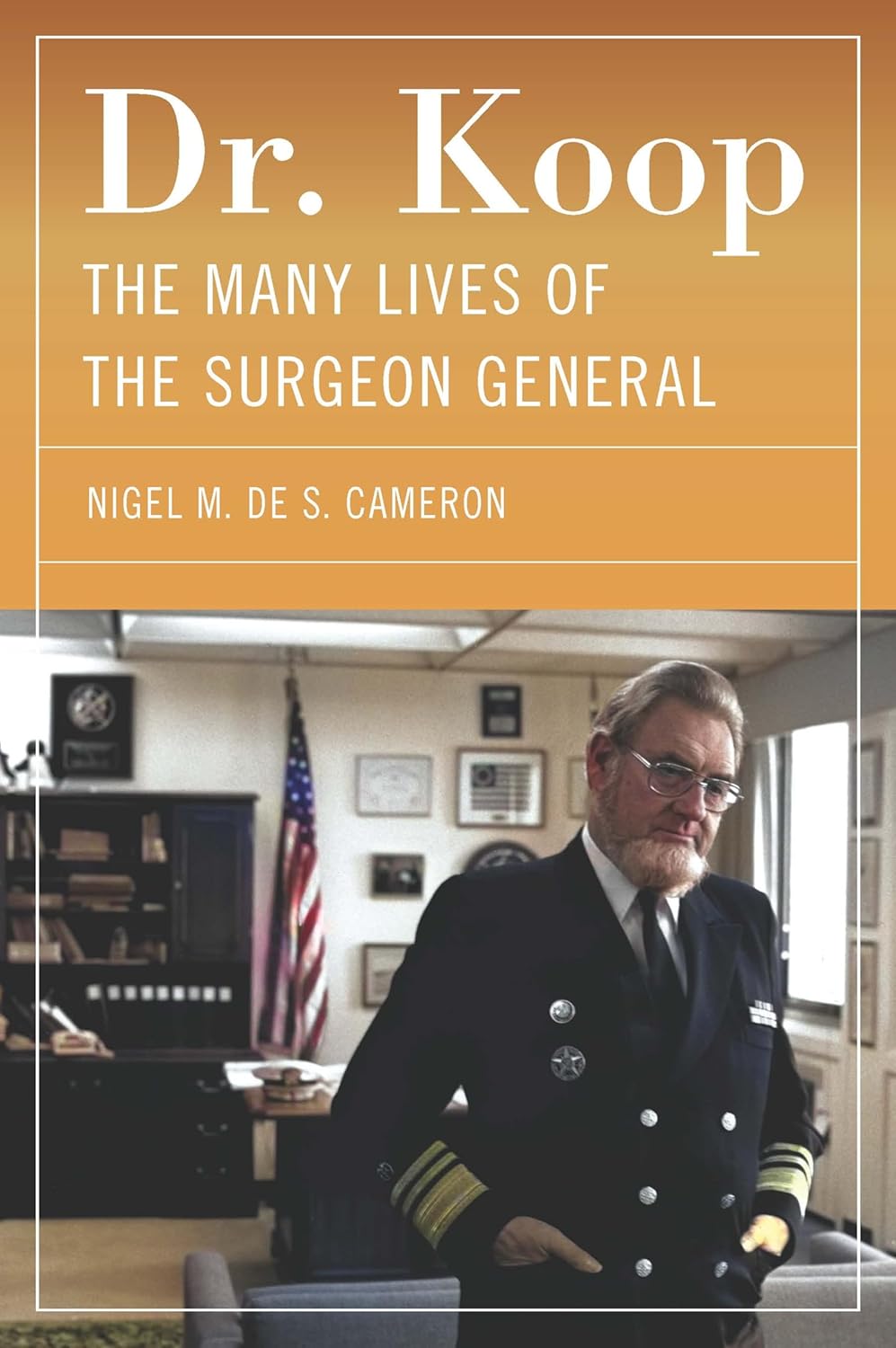
Dr. Koop
Dr. Koop: The Many Lives of the Surgeon General is the first full biography of Charles Everett Koop, the paediatric surgeon turned US Surgeon General whose anti-tobacco crusade and candid AIDS advocacy made him one of the most consequential public health figures of the twentieth century. During his tenure, Dr Koop cut smoking by 25 percent, led the fight against AIDS and shocked both liberals and conservatives on abortion.
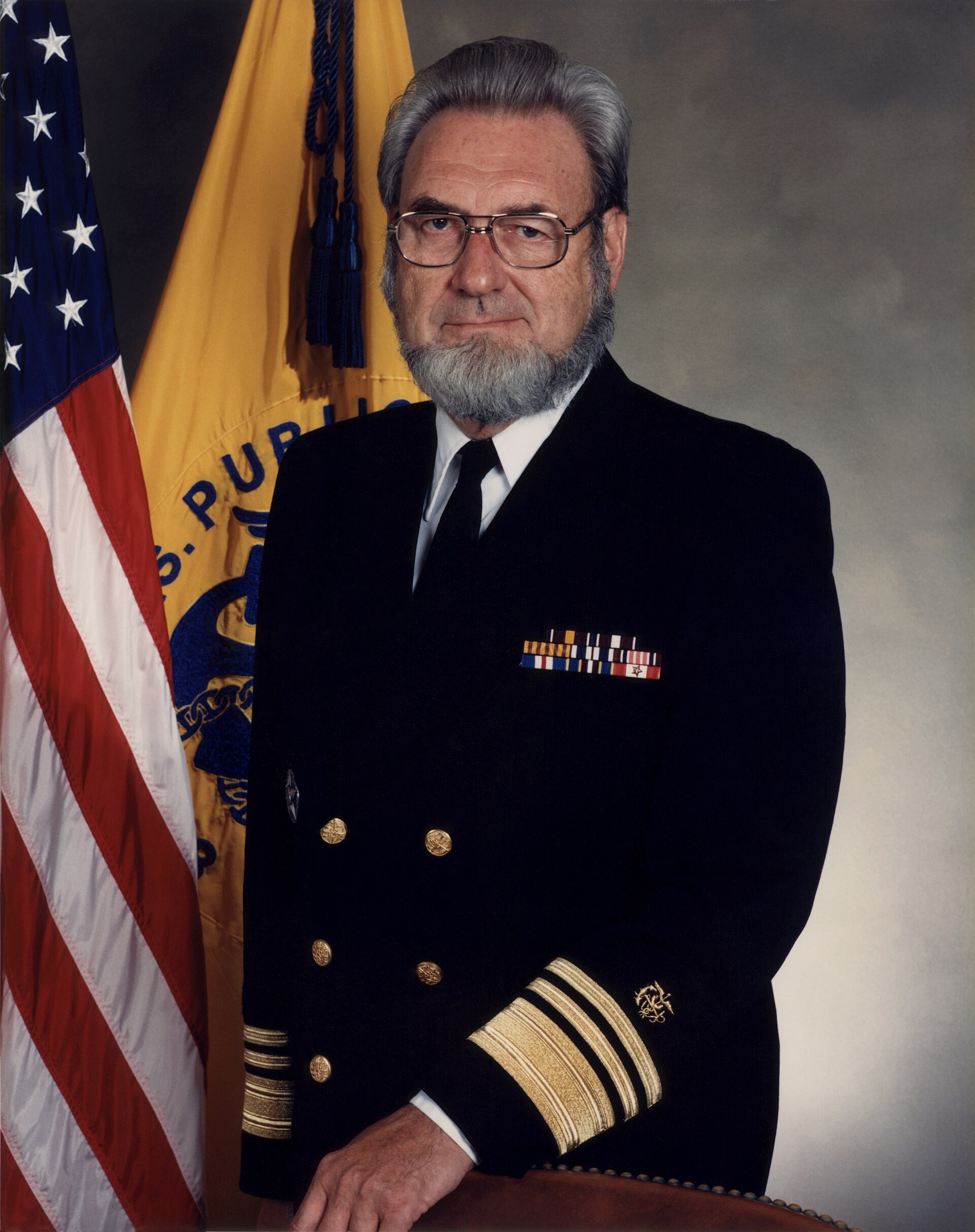
Charles Everett Koop
Between 1981 and 1989
Wiki Commons.
In 1981, when he was appointed as Surgeon General, many Americans were sceptical because of Dr Koop’s staunch conservative views. Some critics even nicknamed him ‘Dr. Kook’. But once in the job, he defied expectations, tackling major health challenges head-on. By the time he stepped down in 1989, this once-controversial figure had earned widespread respect as a bold, trustworthy voice for public health.
Biographers are Resurrectionists
Our conversation traces Nigel Cameron’s four-year research process, including two years working full-time, deep dives into archival material, and his discovery of Dr Koop’s unpublished autobiographical dictations. These private reflections enabled Nigel to ‘get on the inside’ of a human being usually seen only through his public persona. Nigel reveals how his background in bioethics shaped his portrayal of Dr Koop’s contradictions: a socially conservative, anti-abortion Presbyterian who was also unexpectedly compassionate toward the gay community during the AIDS crisis and fiercely effective against the tobacco industry.
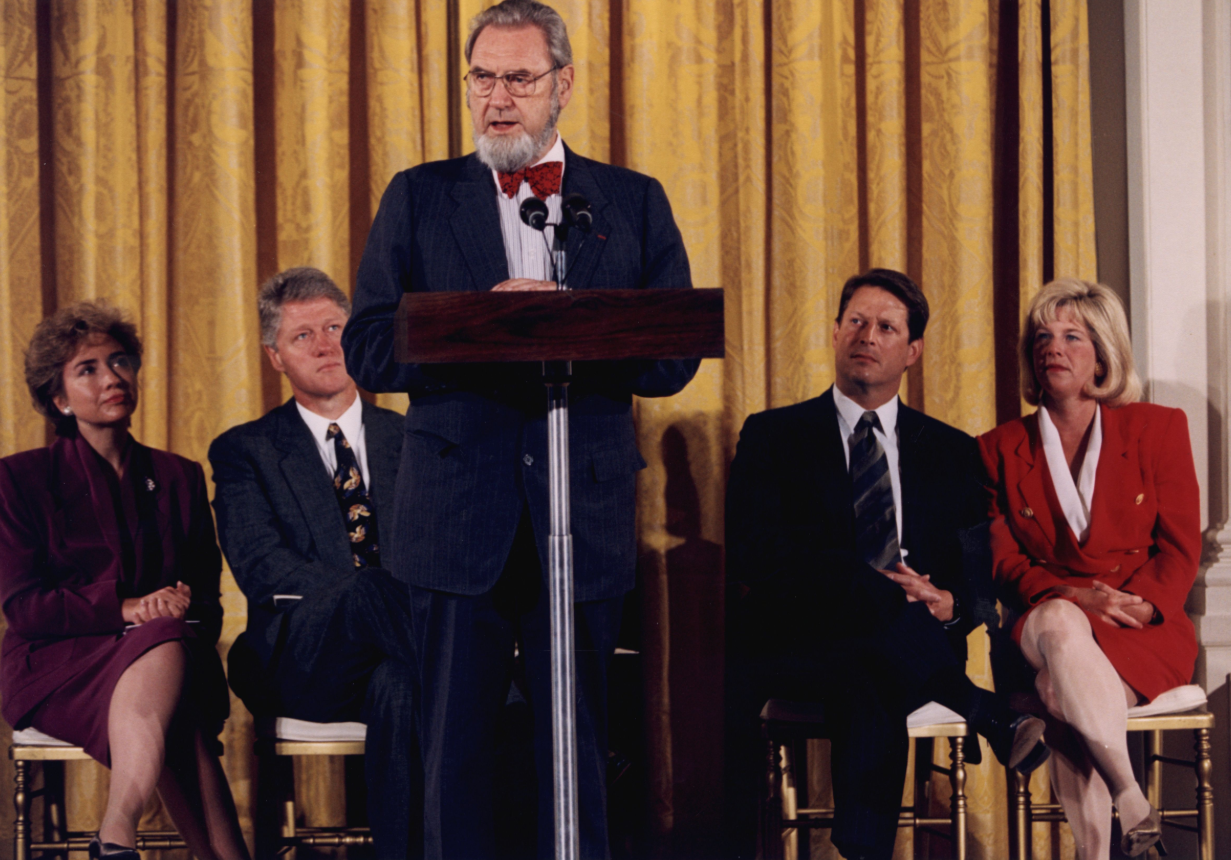
Dr Koop promoting universal health care insurance, 20 September 1993.
Hiliary and Bill Clinton and Al and Mary Gores look on.
Public domain.
Nigel explains how he used footnotes to keep medical terminology accessible, opened the biography with a preface establishing Dr Koop’s significance for younger readers unfamiliar with his legacy and created chapter beginnings and endings for ‘narrative punch’.
Nigel guides us through Dr Koop’s many lives, revealing the surprising complexity behind this public figure. We learn that Dr Koop wasn’t just the stern, bow-tied doctor on television, but a man of deep conviction, compassion and contradictions. Nigel reflects on the challenge of writing a deeply nuanced biography of such a well-known figure, explaining how he balanced praise and criticism, myth and reality, to craft a kaleidoscopic portrait of Koop.
One key takeaway is how Koop’s principled leadership left a lasting legacy. Despite being appointed amid controversy, he defied expectations by putting science and public health above politics. Through his decisions, he showed what it means to stand firm for truth and human lives. In today’s public health debates, his example resonates more than ever. His integrity and courage and his willingness to put people above partisanship are a powerful reminder of what principled public service looks like.
Praise for Dr Koop
‘An exemplary writer’s workshop on how to craft a biography about a famous and richly complicated person. Cameron, who knew Dr. Koop in life, gathered research from a host of individuals who were willing to share their many personal insights. The resulting opus recognizes the memories of Dr. Koop’s inner circle of friends and colleagues and balances those with the observations and recollections of many others with whom Dr. Koop interacted professionally.’
—Medscape
‘Cameron sets and meets a high bar—to record in detail the lifetime achievements and candid critiques of a man who wrestled with the most challenging issues in ethics and medicine, issues that traverse vital questions of life and death in a society under stress.’
—Chuck Donovan, The Washington Stand
‘As Cameron documents in his readable Dr. Koop, it was his career as a public servant defined by a steadfast commitment to integrity and honesty that made Koop an enduring figure—a model to be emulated by officials in any presidential administration, past or present.’
—Washington Post
‘Koop became a standout in the Reagan administration, taking on the tobacco lobby and the fight against AIDS. [In this] well-researched and -considered biography. . . Cameron laments that Koop has been virtually erased from public memory.’
—Carl Rollyson, New York Sun
‘Cameron’s in-depth look at one of the most interesting and complex figures in American public health provides unvarnished context for Koop’s critically important leadership at the start of the AIDS epidemic and on other critical public health issues.’
—Jeffrey Levi, former executive director of the National Gay and Lesbian Task Force
‘At the heart of Nigel Cameron’s comprehensive biography lies the blow-by-blow account of how ‘Dr. Kook,’ as some of his critics were calling him, became a hero to me—and to many millions of Americans—and the public health leader of his generation, as he turned his ferocious energies to battling the tobacco companies, championed the needs of handicapped children and victims of domestic abuse, and led the fight-back against AIDS. We’ve waited a long time for this story to be told, and as Washington gets yet more deeply divided there could be no better time to be reminded of a man who was driven not by politics but by principle and moral courage.
—Henry Waxman, former Member of Congress
‘No one did more for American public health than C. Everett Koop. And that came after no one did more for pediatric surgery than C. Everett Koop. Cameron’s Dr. Koop tells this story with brilliance and luster.’
—Gregg Easterbrook, author of Surgeon Koop and It’s Better Than It Looks
‘Chick Koop was the role model for the modern surgeon general. His positive impact on the public’s health was profound by any measure and this biography is an opportunity for us all to better understand the life of such a remarkable individual. Dr. Koop: The Many Lives of the Surgeon General is a well-researched biography of the man who redefined the role of our nation’s top doc.’
—Georges C. Benjamin, MD, executive director, American Public Health Association
‘Had Dr. Koop never been Surgeon General, his development of the field of pediatric surgery still would rank him as a foundational figure of 20th-century American medicine. His tenure as Surgeon General at the dawn of the AIDS pandemic, his work on tobacco control, his nuanced statements on abortion, elevated him to near-mythic status. Cameron’s meticulous and balanced biography does justice to the extraordinary life of this complicated man.’—Steven Bernstein, director of the C. Everett Koop Institute
‘This is a beautifully written and meticulously documented account that goes behind the many landmark accomplishments of Dr. Koop. It is a study in leadership and greatness that will be appreciated by and inspiring to people from all walks of life.’
—Jack Henningfield, Johns Hopkins School of Medicine
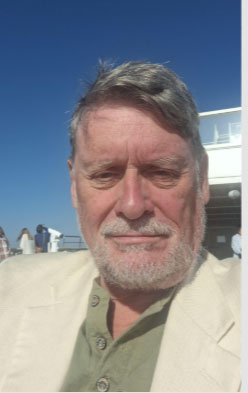
Nigel Cameron, once a university professor, then head of a Washington think tank on the policy impact of technology, published his first biography, Dr. Koop: The Many Lives of the Surgeon General, in 2025. His current work is on Ruth Tiffany Barnhouse, who was Sylvia Plath’s psychiatrist, due out in 2028. He’s also writing a group biography of schoolmasters at the high school he attended in the 1960s, four of whom were Hitler refugees. Nigel and his wife Anna divide their time between Brussels, in Belgium, where Anna is an official of the European Union, and their favourite place, their home in Boulogne-sur-Mer in France. In addition to eight children, fifteen grands and a great-grand on the way, their blended family includes two little, long-term foster kids. They’ve also hosted, so far, twenty-three Ukrainian refugees. Nigel gets up early to write!
Episode transcript
Gabriella Kelly-Davies
Nigel, welcome to Biographers in Conversation.
Nigel Cameron
It’s great to be here.
Gabriella Kelly-Davies
Please tell us about Dr C. Everett Koop.
Nigel Cameron
He was, in the 1950s, 1960s and 1970s, the world’s most famous paediatric surgeon. He was also what in American terms would be called a social conservative. He was a committed Presbyterian Christian. He became strongly anti-abortion and conducted an anti-abortion campaign in the 1970s, which brought him to the attention of the Reagan administration when it came to power at the end of that decade. And Reagan makes him Surgeon General, which was then a relatively low-profile backroom job, but Koop turns this into the most important public health job in the world.
That’s a quick version.
Gabriella Kelly-Davies
It’s a very quick version, given the many dimensions of his life. This is the first full biography of Dr Koop. What inspired you to write it?
Nigel Cameron
Well, back just before COVID. This is, you know, BC, before COVID. I mean, I was retired in principle and had a little time. I was doing some more writing. And it just came into my head: what happened to Koop?
Now, I knew Koop. I met him in the 1980s, and we stayed in touch over the years. He died back in 2013. I wasn’t super close to him. But we were friends and kept in touch.
And so he just popped into my head the way people you haven’t thought about for years pop into your head. And, of course, we had Google. I was just very surprised to find there’s no biography, no serious essays and so on beyond the obituaries published when he died. Biographers can work for years and years on a subject, so I wondered how I could find out whether anyone else was already working on him. How could I discover whether anyone else was already down the coal mine, digging away?
And I thought: Tony Fauci—yes, absolutely. Because Fauci, I knew, I’d met Fauci several times. I mean, Fauci wouldn’t have remembered me, but we met at some conferences, some sort of small, rather elite sort of Aspen conferences. And we discovered we were both friends of Koop’s. This is, you know, going back more than 20 years.
And I know this is before COVID because Tony was still doing his own email. Oh, right. Okay. He won’t be doing that now. A few months later, I would never remotely have got through to him through all the layers because, I mean, he then became super famous.
And anyway, so I just wrote and he said, no one is talking to me about Chick—Koop’s nickname. And he’s like, I think this is a great idea. So we had some interviews and so on. And he was being very encouraging. But so I thought, well, I wasn’t planning to become a biographer, but I thought I maybe should do this.
So I asked various friends, one or two historians and other friends. They said, “Nigel, you should do this.” And of course, I got bitten with the biography bug in the process because I found it such an enriching experience.
Gabriella Kelly-Davies
How did you learn to write biographies if this was your first biography?
Nigel Cameron
I read a great many of biographies and I thought a lot about what’s going on here. One of the nicest reviews I’ve had, I mean, this is sort of a bit over the top, but one reviewer said that this is something like a masterclass in how to write a biography of a famous person. That’s quite the thing. And I didn’t even have to pay him to say that. But I’m intellectually somewhat gregarious.
And I put a lot of effort into thinking about what’s going on. When you put someone’s life together, you tell a life story. And I took a long time to do it. I mean, it took me four years, at least two of them full-time. I put a huge amount of effort into this.
And I spent a lot of time with the people who knew more about the subject than I did. I mean, paediatric surgery, what is that? So, I mean, I could now give some decent lectures on the history of paediatric surgery. I spent a lot of time becoming, you know, a sort of mini expert, so I could do that. I also did a great deal of background research into the other areas he entered.
I mean, I’m an academic, so I know how to do that kind of thing. And I also spent an awful lot of time in the archives. One thing that really helped me is that two or three times in his life, Koop got interested in his own life. I mean, from an autobiographical point of view, and dictated, you know, a few pages—or, on one occasion, perhaps thirty or forty pages of what could have become, you know, a memoir. And when he stepped down from government, he published a sort of post-office memoir that his son, who is a historian, basically wrote.
And it’s all designed for the public. But I mean, he dictated these things, and probably no one else has ever read them. So I was really helped by having these reflections from the man himself at two or three different stages in his career, which I think helped me to get on the inside, if you like, of somebody whom I’d met from the outside and, of course, then read about from the outside.
Gabriella Kelly-Davies
I’m curious about the title, The Many Lives of the Surgeon General. What does it reflect about him?
Nigel Cameron
Well, the way that I put this in a somewhat humorous, but not entirely humorous way, is that Koop made two big mistakes if he wanted someone to write his biography. And, of course, he did. This is another thing. I mean, he was certainly expecting to be written about. He was a big man and knew himself to be one—a big ego and a big surgeon.
One mistake was that he lived too long, which is a real problem for a biographical subject: he faded from public view over many years and lived until he was 96. His second mistake was that he simply did too many different things. I once asked somebody who had written an essay about Koop why he hadn’t written a full biography. He replied, “It would be so much work, because he was this, that and the other.” And it wasn’t just that. A lot of people who remember Koop or who knew Koop have a very high regard for him.
But on almost any issue, they would want to add a footnote. So, you know, he was a social conservative. He was a Presbyterian Christian. But he formed warm relationships within the gay community. While in office, he was more concerned about tobacco than abortion.
And so on. Some leaders in the gay community are still around and absolutely thought the world of him, despite his background as a socially conservative, anti-abortion campaigner. Very few people, I think, would endorse his whole agenda. That makes it difficult to present him as an entirely sympathetic figure when you’ve got to start adding the footnotes. I think there are issues of that kind that make him fascinating as a subject but also complex and somebody who would be a challenging person to get inside.
Gabriella Kelly-Davies
Absolutely. How did your background in bioethics influence how you portrayed him?
Nigel Cameron
Well, the way I first came to meet Koop was I was in Edinburgh in Scotland and I was running a project on medical ethics, as we called it back then. It was more medically focused than the broader bioethics discussions we have today. I’d heard of him through the press. That was the only way I heard of him. I knew about his position on abortion, but I also knew about the Baby Doe case.
Now, Baby Doe was a very famous case while he was Surgeon General, concerning the mistreatment—or lack of treatment— of a disabled newborn baby who was abandoned and died a few days later, which became a huge political issue in the US and brought together people from left and right at a time when treatment of disabled newborns could be alarmingly lackadaisical. And it’s partly this that got Koop into the anti-abortion movement because he thought these things were all the same. You know, people were abandoning little people. But anyway, he was famous because of Baby Doe. And we were setting up a series of lectures on medical ethics in the UK.
So I wrote him a letter. Back then, you had to type letters and put them in the mail. But I thought, well, it takes you half an hour to do that. Who knows? He probably won’t come.
But then I received a phone call: “I’d love to come to England”—although I was in Scotland. And he said, there are things I can say more easily outside the country than inside the country. So it was about a year later, but he came over for a week. And we set up two conferences in Edinburgh and London, and he was the star. And I arranged various lectures at medical schools around.
And we travelled about for the week, and we became friends. It’s interesting how these things happen. I mean, you know, you can get close to people when they come onto your campus or whatever, and you spend time, and then they go away, and great, we’re all friends, you know. But when he went back, I sent him the traditional little, you know, thank you letter with a cheque for some of his expenses. He wrote back with a cheque for $100 and said, “Look, Betty and I want to take you two out for dinner.” It was lovely.
He was a great maker of friends. And one could say, and I probably have this in the books, one of the more sensitive aspects of his life was that, he often made friends around the same age as his own kids with whom he didn’t get on very well.
Gabriella Kelly-Davies
That’s interesting, isn’t it?
Nigel Cameron
So, you know, he got married again when he was 93. He’d been widowed for a few years. And neither of his two surviving sons went to the wedding. But he was a great maker of friends. And a lot of people, younger people particularly, became very close to him.
I was on the penumbra of this circle. But then we moved to the States a few years later. And he got me onto a non-profit board with him. We would meet, you know, several times a year. And that was a valued friendship.
Gabriella Kelly-Davies
Why is his story still so relevant today?
Nigel Cameron
Well, there are several ways to answer that question. And one could have answered that question, you know, before Mr. Trump got on the scene the first time, quite apart from the second time. But of course, science, public health and politics have always had an uneasy relationship with each other. Koop himself used to say that medicine and politics didn’t mix, which made him an interesting candidate to become Surgeon General.
But he is regarded by many as this great hero who said science had to make the decisions. I mean, science was what counted. It’s not a matter of policy or other considerations. You’ve got to follow the science. And now, of course, this has become a much hotter issue in Washington and therefore around the world than it was even before.
Although there have always been arguments about policy and science and politics and public funding of science and so on. And so now he becomes an extraordinarily relevant figure at a time when public health science in the US is being manipulated by some very narrow and rather eccentric political considerations. And I wrote a slightly tongue-in-cheek piece for The Hill, which is Washington’s political newspaper. I wrote a slightly tongue-in-cheek op-ed because President Trump nominated a young woman doctor, who was, I think, in her thirties and an influencer, to be Surgeon General. I wrote that I wasn’t getting involved in the pros and cons: she may be a smart person.
She may be somebody with bad judgment. But I said, basically, Koop was an influencer before we used the word. This is what he did. Because his job had very little power. But he used his personality and his prodigious energy and intellect and so on to project influence in a way which was quite extraordinary in American government.
And toward the end of his time in government, well, you know, David Kessler, you know, who was FDA commissioner, a highly respected elder statesman of American public health. He said Koop was able to accomplish far more than any member of Reagan’s cabinet.
Gabriella Kelly-Davies
That’s extraordinary.
Nigel Cameron
And he did it by being what we would now call an influencer and knowing how to use the levers of influence right across the board. When he had no power, his campaign against tobacco was a classic example of this. Because the US government obviously had official concerns about tobacco, and there was an annual report that the Surgeon General would sign. But of course, this is a conservative government, Big Tobacco, huge American industry. Jesse Helms, who was one of his top backers, Senator Helms, old-style Southern conservative, when he was appointed, was the kind of patron saint of the tobacco industry.
And Koop comes out. forcibly against tobacco. And then he comes up with this notion of the smoke-free society by the year 2000. This was a huge campaign he ran. And he goes to the annual conference, the American Lung Association, and he makes an extraordinary speech, which he wouldn’t even let his aides see. This was typewritten by him and typed up in the offices of the American Lung Association.
And he launched what he called the Campaign for the Smoke-Free Society. Now, he has no authority to do government things there. And he says, this is what is so wonderful, because the government need not be involved in this project. It is for civil society. It is for your organisations.
It is for these networks. You are the people who will make this happen, because you want there to be a smoke-free society. It was a tour de force and a quite extraordinary approach. And the speech is worth reading over and over. He’d written this.
He was in Switzerland at the World Health Organization for three weeks representing the US. And what he was really doing was writing this speech. Wonderful. And it was revolutionary. And during his time in office, the eight years he was in office, smoking fell in the US by, I don’t know, almost a quarter.
It had been coming down slowly. It carried on coming down slowly. It is now, I don’t know, around 15 per cent or something. But it was in the mid-30s and it went down to the mid-20s. And it was Koop.
I mean, the tobacco industry records are all coming out now, minutes, this, that, and the other. They said, this is Koop. Koop is the guy. Koop is doing this. And it was this force of personality and these very clever ploys, which took everybody by surprise.
That was to our benefit.
Gabriella Kelly-Davies
I think so.
Nigel Cameron
Interestingly, Koop had been a pipe smoker. It wasn’t all part of his sort of religious thing to be anti-smoking. He gave up the pipe, you know, in the 1970s when evidence emerged that even pipes were bad for you, which is why it was such a surprise when he decided to go after Big Tobacco, and he did them considerable damage.
Gabriella Kelly-Davies
It’s extraordinary, really, given the political power of Big Tobacco and the amount of money they contribute to political parties.
Nigel Cameron
Yeah, he analysed the situation quite well, that he said smokers are not a well-organised group. There’s no big civil society group of smokers. Where are the smokers who lobby Congress? You have Big Tobacco and these enormous companies, supported by people on both the right and the left of American politics. Koop mobilised the opposition.
And also, he pushed this down to the level of the states, to the level of cities and towns, and to the corporate level. And he said, you people need to do this. Now, Big Tobacco has great lobbyists in Washington. They had much less power in state legislatures and virtually none on city and town boards. He told local communities that they could ban or regulate smoking.
There was very little regulation of smoking in workplaces when he came into office. And when he left office, it was a standard thing in workplaces to regulate smoking in various ways. I mean, the labour unions were very much against him. And their argument was, actually, smoking is a good indicator of air quality. And therefore, people need to be smoking in the workplace so we know which way the air is blowing and all that kind of stuff.
But they finally lost that argument.
Gabriella Kelly-Davies
Wow, he’s a master grassroots political campaigner. You opened Dr Koop with a brief preface. I’d love you to read its opening passages.
Nigel Cameron
Yeah, so this is my sort of introduction to Dr Koop for people who maybe haven’t even heard of him. C. Everett Koop is important for many reasons beyond his astonishing résumé and ripe for presentation to a new generation. Back in the 1940s and 1950s, as he rose to prominence as a paediatric surgeon, we find him, the social conservative, fighting racism, fighting what we now call ableism, standing up for Jewish colleagues, boosting women in surgery, and week by week spending long hours with the down and outs on Philadelphia’s Skid Row. Appointed Surgeon General by Ronald Reagan, he proved a model of integrity under political pressure—something Washington now sorely lacks—and a byword for honesty in public health.
A man of intensely strong moral and religious convictions, with a manner that many found gruff, he nevertheless, in his quest for health and life, he reached out across traditional divides. After Senator Edward Kennedy refused to vote for him, Koop refused to shake his hand. Congressman Henry Waxman led the opposition to his appointment, calling him a man of tremendous intolerance. Ted and Henry would soon become friends, as well as allies, as Koop took on the tobacco companies and led the fight back against AIDS. It is remarkable that more than forty years after he took office, there is still no full-length Koop biography.
Potential writers have perhaps been put off by the sheer multiplicity of his endeavors and the complexity of his convictions. The innovative paediatric surgeon lauded as the father of the specialty, the deeply religious campaigner for the value of human life before as well as after birth, the outsider nominee for Surgeon General, who by force of personality turned a backroom job into a steamroller shaping the federal approach to public health. Then came his third career, as he parlayed his fame as America’s family doctor into a series of initiatives focused on health communication. As the twentieth century drew to a close, the octogenarian Koop helmed the world’s leading healthcare website.
Gabriella Kelly-Davies
Why did you open the biography with this preface, and what’s its significance?
Nigel Cameron
Well, it is partly because my experience in trying to find a publisher for this book really quite surprised me. I mean, I had one major press that was very interested. For three months, the proposal went through reviews, and the guy tells me, I’m going to write you a great email tomorrow afternoon after our board meeting. And he writes me an email the next day saying, I can’t believe this. He said, we spent almost the whole meeting talking about this book.
He said, everybody under forty hadn’t heard of him. So I thought we’ve got to establish who this guy is for people who’ve actually gone and bought the book and confront them with these basic facts about him, which those sort of Koop fans would pretty much know. And things like this little story about Ted Kennedy, which I got, wouldn’t shake his hand. I got that from a guy who was there and saw this. That detail was fresh, new and special to my account.
You know, I mean, Ted Kennedy turns up to congratulate him on the Senate floor after he’s been confirmed, went up to his wife, Betty, who’s a very sweet lady, congratulates her, went up to the great man and Koop turned away and walked off. But things were to change. And it’s a very moving story later on from a woman journalist who actually was a staffer who said later on, Koop and Ted Kennedy would meet once a week and they would go for a walk around the White House grounds together and basically brainstorm how they could work on public health.
Gabriella Kelly-Davies
Did you experiment with other openings or did you know this was the right one from the beginning?
Nigel Cameron
Well, I mean, there’s an intro and a preface. And I followed that with a little account of his ninetieth birthday party, where I was, which was co-hosted by a conservative senator and Hillary Clinton, who was there. My original plan was simply to begin with the birthday party. and let the story unfold from there. But I think my experience on finding how forgotten he had been meant I needed to do a bit more sort of due diligence in getting the basic facts about him up front before this sort of rather charming sideways way in was going to be comprehensible. So that’s why I did it this way.
Gabriella Kelly-Davies
I thought it was very effective, you know, given his age particularly and that he’s out of public consciousness. Biographies often involve conflicting accounts of a subject, especially for a polarising figure like Dr Koop. How did you reconcile these contradictions and the conflicting stories about him?
Nigel Cameron
Well, I think the simple answer is with difficulty. You know, what’s the next question? He had these different lives and it wasn’t just that they were different careers. They were different strands going through his life. I mean, he had this very strong sense about abortion and some other moral issues.
He held what would now be regarded as strongly conservative views on homosexuality. I mean, you know, When Obama first ran for office, he did not support same-sex marriage. Things have changed enormously in a generation. Koop was on that side of the divide. On the other hand, he was very gracious in dealing with individuals.
And he had this sort of very... Even in the 1950s, I mean, he was supporting Jews. He was supporting women. He was supporting disabled people in a way that no other conservatives were. So these strands, this is all very complex.
And so I think part of my way of coming to terms with these different accounts of him is to recognize where they came from. People have taken different pictures from different angles, this multifaceted man. And how do these things fit together? And do they fit together? And I think there are certainly some contradictions there that he didn’t really, you know, resolve in his life, and which are part of what set him up, if you like, for failure at the end.
Because, you know, his final years, he was very depressed. I think I came to believe that he experienced depression. I mean, this is not evident almost anywhere. I don’t know anyone who has said that. But I found an account from the 1950s, which I’m sure nobody has read, where he was making notes for himself.
And considering a change of career, because certain events have basically thrown him into a serious depression. So I think that that is there. And I think now if I were writing it again, I think I would make more of it. But I think you see these different aspects. And I think they catch people unawares.
They embarrass his friends. They meant that people would say about him, you know, I really wish he wouldn’t do these things, but I still love the guy. So I think in a sense, these different narratives, different ways of writing about him, my task was to embroider them together, which gives you the guy. But I don’t think he really quite understood himself in this way. He certainly never understood Washington politics.
He didn’t understand the impact he had in all sorts of ways. He was much more naive than I think he realised in politics. One of the people who knew him well in later days said, you know, he sort of hammed it up successfully. I mean, he was really quite good at PR and so on. And this gave him the impression he was always going to be the best person and he didn’t have to take advice.
And so he became involved in business dealings that really were a mistake. And he was told they were a mistake by his friends. And in a sense, his character comes out in a most complicated way in his time after he retired as Surgeon General, stepped down, when he gets into various business dealings and non-profit ventures. And I could have written a whole book about that. I had to slash away at that whole section of his life because it wasn’t the primary interest, at least to publishers.
I think it was in the years after he was Surgeon General that the complexity of his life, of his character, of his convictions became most evident. And I could have written a lot about this and had to cut a lot out from my drafts because the main interest in him is not in this section of his life. And this is when it became controversial. He was criticised in the press. He didn’t disclose his interests while he was testifying to Congress.
He got involved in some business ventures that didn’t go well. and was criticised. And, you know, one of his friends said to him, look, Americans want you to save lives and fight AIDS. They don’t want you to become an internet millionaire. And he found this hard to manage because he thought, well, I’m the great man. I can make my own decisions.
You know, let the chips fall where they may. And the chips fell. And he got into serious criticism. And One of these revealing incidents, about which very little was written, there was one or two press reports of this. In the middle of all these controversies, he gives a press conference to about 50 newspaper editors from New England.
And he wants to fight back and say, well, you know, yes, okay, I got involved in these business ventures, but for good reasons, and so on. And halfway through, he just stops and starts talking about the death of his son, David. His son, David, was in college and was a climber and was killed in an accident in the late 1960s. And he just stops making this speech about how wonderful he is and how he’s always right. And he tells a story.
He says, shortly after David died, I had been scheduled to make a speech at a prayer breakfast. And it was a few weeks later, but I went through with the invitation and had my speech ready and was making it. And I stopped halfway through. And he says, I just had to tell people that my son was dead. It’s deeply affecting.
The whole thing is deeply affecting. And this all comes back to him in the middle of this controversy a generation later. And he doesn’t break down, but if you like, inside he breaks down. And he’s brought back to a different kind of reality, which isn’t about this carapace, the great Koop, you know, I’m the man who can do it all, you know, pushing back against criticism. It’s the dad whose son died.
And his son’s death had a profound impact on him and on the family and on the other children. One doctor whom I quote, who was a close friend of his, toward the end said he would talk more about his dead son than about his living children. And so you do break through somewhat and see how the various dimensions of the great Koop fit together and also don’t fit together and were never actually integrated. So that’s a somewhat roundabout response to your question. But I think there’s scope here for other books about Koop, and I’d love to read them.
Gabriella Kelly-Davies
So how did you balance all these different parts of his life, and how did you reconcile these business dealings with the man who… you know, was so fervent about AIDS and abortion and, I guess, also, you know, the profound effect that it had on his son.
Nigel Cameron
Well, one comment about his four kids and his own background, I mean, his father, he was an only child. His mother had lost a baby before, but he was the only surviving child in the family and had doting grandparents living upstairs and so on. And he was absolutely a spoilt kid. Yet he wrote an essay in his teens saying, I wasn’t spoiled, but this is what happens. And his dad was in a bank.
And day after day, he’d go to the New York Public Library to look up answers to questions raised by his precocious son. This was a very common thing. And he said his father was his best friend. And they were very, very close. And when he had children, he was often living at the hospital for three, four days in a row.
And a little Freudian slip. At one point, he says he has two toddlers. He describes them as his wife’s toddlers. “His wife is at home with her toddlers,” he said. And okay, well, that’s often the medical life.
But in his case, it was extreme because the one day he had off, typically off was a Sunday, and they go to church. And then after an early dinner, he would be off to Skid Row to help with the down-and-outs with a team of students. He did this for months and years. At one or two points, he says, maybe I overdid it, you know. So then he comes, you know, when the kids grow up and they just don’t see much of it.
One of his final trainees, whom I spoke to, who became a very senior paediatric surgeon said, look, he said, when my son had a little league game, I would just tell my secretary, you put it in the schedule. Now, I don’t know how Koop just would have done. His wife will do that kind of stuff, you know. And this really tells and it tells in old age. In fact, I still hope to meet his eldest son, who is still with us and is in his late seventies, who is a professor of history as well as a pastor, and who has been politely responsive to my emails, but obviously has not been enthusiastic about the book.
But one of his best friends, speaking to me plainly and on background about the family, said, oh, yeah, the elder boys who survived, they had a bad relationship with the father, but his daughter, who is also still with us, that was worse. I simply listened. I know some of this. I don’t make a big deal out of it, but I think it is a big deal. And it’s a lesson.
Goodness, why do we write and read biographies? So that we can learn things about our lives.
Gabriella Kelly-Davies
Yes, I think people forget that being a biographer is very autobiographical. So what storytelling devices did you use to make the biography read like a novel rather than a dry account of a public official?
Nigel Cameron
One of the features of biography, as of course you and I’m sure our listeners know very well, is that it’s a sort of sliding scale here, but basically it’s a very scholarly academic enterprise which aims to present material to the general reader, whoever that mythical figure may be. And not everybody writes at the same level with notes. I’ve got about 80 pages of footnotes and I can sort of defend every line, you know. But you have to make the thing readable. Now, Koop’s life was fascinating, but you could also produce a version of it that read like his CV, which would be somewhat less fascinating.
And so I sought to tell stories and to find stories which would make points themselves, rather than my having simply to make points. You know, I don’t say, well, these are three aspects to his character which we need to discuss. I would tell stories about what he did. And obviously, I mean, I got people to read it. I asked perhaps twenty people to read two or three chapters each.
People I’d interviewed mainly, but other people, critical responses here and there. I also devised my own little critique of the story angle. And I assessed the beginning and the end of each chapter on a scale of one to three. I thought one to three was appropriate for this. I gave them all a score two or three times as I worked through different versions.
I didn’t get them all up to ones, but I got them all to ones and twos just for the kind of punch they packed. a sort of sense of resolution at the end of the chapter, like a glass of water between wines, clearing yourself so, you know, you can start again. And so, I mean, intuitively, I came up with a number of these devices to help me. Something else I made a point of doing, especially in the medical material, mainly in the three chapters at the beginning on surgery, because a lot of doctors will read this. I didn’t want to make it too simple. So I made a decision to use footnotes.
I don’t use footnotes in general. I mainly use endnotes. But I use footnotes to explain medical terms. So, you know, if you have a non-union fracture, he broke his leg. It was a non-union fracture.
I use the medical term in the text and say, you know, that’s a fracture that doesn’t heal easily. That was another decision I thought through. I mean, do I use the medical terms in the text? Yes, I do. But I use footnotes.
Gabriella Kelly-Davies
That’s a good way of translating medical concepts into language for the general reader.
Nigel Cameron
You can go either way. You can either use, in the narrative, you can say a fracture that didn’t heal, and then down the bottom for the medical people, you can say the medical term.
Gabriella Kelly-Davies
Non-union.
Nigel Cameron
Non-union, yeah.
Gabriella Kelly-Davies
Why did you use footnotes rather than endnotes? I’m fascinated by that.
Nigel Cameron
Well, I only did that for these things and certain other, I mean, you know, people who read books with endnotes. Probably only one in ten readers engages with the endnotes, you know. I was interested, of course, Cora, whom I came to know, who’s a lovely, lovely woman and who’s been very helpful with the book. And she got a copy and she said, well, I’ve been reading. And she said, you know, with two bookmarks, reading the text and all the notes.
And most people don’t. So with things like this and just a smattering of other things, I did use footnotes. I mean, for example, I’m talking at one point about he having a fight with his boss when he was a junior surgeon, about how much he’s being paid. And it was, I don’t know, perhaps $2,000 a year. I thought, what does that mean?
So I thought that was worth a bit of research. And a little paragraph on a footnote explaining, basically, what the average wage was there for a family of four, how you translate that in today’s inflation-adjusted terms. And so I thought, there are a few things that is where I thought the reader needs to know. Another time, he says the temperatures are minus 40 degrees Fahrenheit on a ski jump he was doing. Well, that seems pretty implausible.
So I went into the records, did a couple of hours work, and that went into a footnote as well. There’s something the reader really needs to have. And I sometimes wish I had used more footnotes, although I might just have got bashed over the head by the copy editor for that. But I got those in where I think the typical reader needs this information. It isn’t merely an extra they can seek out if they wish.
Gabriella Kelly-Davies
But a lot of editors and publishers these days don’t want footnotes. They want all the information at the back of the book.
Nigel Cameron
Yeah, I mean, I think that was a much cheaper way to print books in the old days when you were using letterpress and things like that. Because messing about with the text when you have, it’s a nightmare. And now it doesn’t really make any difference at all. And I think it’s from my point of view, I mean, who is a typical reader? Well, I’m hoping this book has been read by many people who are not doctors, but a lot of readers will be doctors.
And so I think the main text needs to be doctor friendly. They need to have a sense that, well, this Cameron guy is not a physician, but at least he gets our language and he can talk our language. So I did it that way around. If I had my druthers, however, I’d probably use more footnotes. Because, I mean, there’s some gems, there are absolute gems back there in the endnotes that hardly anyone’s ever going to see.
Gabriella Kelly-Davies
What a shame. And you spend so much time getting the detail 100 per cent correct. How did you navigate the balance between Dr Koop’s public persona and his human story?
Nigel Cameron
I think it’s his public persona which obviously attracts people and has sort of defined him. Well, for example, I do talk about this capacity he had to make friends. So he and Fauci become friends. Fauci, you know, basically is, you know, a generation down, typical sort of Koop friend. And he had older friends too.
But I talk about this friendship capacity he had, and obviously some of these friends and some of the stories. I mean, for example, the NBC medical correspondent, Dr Timothy Johnson, became a buddy of his. He was interviewing him in Washington and they hadn’t met before. Johnson was interviewing him for, it was for 20/20, I think, a high-profile program. And they spent a day recording in this, probably in a hotel room, which is what they often do—and discovered they were both going to the same banquet that evening in Washington.
So Koop said, well, I’ll just come along, you know, jump in my car. Then they went back to Koop’s house afterwards, you know, for drinks, I suspect—on the NIH campus. and talked until two in the morning. And they’re buddies and they’re buddies for life. They end up writing a book together. But he had a gift for acquiring friends.
I mean, I think this is one way in which the public and the private really, you see how they mesh. He had a very loyal little staff when he was surgeon general. And there’s one lady who worked for him who’s now also deceased, who was interviewed by a friend of mine, and he shared the interviews with her. And she said, well, he was pretty thin-skinned. We had to stroke his ego, but he was very nice to his team.
And so one of the little tricks he would use, so when he made a speech, and he was always making speeches, and he ended up having some speechwriters, when it came to jokes, partly because he was just a very conservative guy and so on, he was very concerned about misunderstandings and innuendo and so on. So if I have this the right way around, he shared the jokes with his wife and asked whether they were appropriate. If she thought they weren’t, he would ask his staff to vote. So his staff had this really, very sort of warm relationship with him. And he was quite relaxed.
I mean, I have a story that one of his colleagues at the C. Everett Koop Institute at Dartmouth, his base later in life, described all the honorary degrees from every university in the world. And he’s come in there, you know, wearing his L. Bean boots that are all muddy. And he wants to sit down and talk about where they could go for a good lunch of Korean chicken and waffles.
And he said, you know, he described him as a man’s man. He said, you know, he was very human. He said that when they went out to lunch and there’ll be a lot of great appetisers on the menu. And he wouldn’t have a main course. He’d just have one of each appetiser.
And he said he would have three double martinis. You know, so I mean, the love of food, I mean, I asked Tony Fauci, I said, “What did Koop like most?” He said, “He liked to eat.” So, you know, there are these very human dimensions. In fact, Koop kept his weight under pretty good control, but he loved this braggadocio, you know, one of his colleagues said, you know, I used to tell him, if you’re at a reception and there’s food, I mean, don’t put so much bacon on your plate at one time. You know, you’re the Surgeon General. One of these events I organised for him in 1986 in the UK, we were at a very prestigious medical school.
He was giving a lecture and we had lunch with the Dean of Faculty. And halfway through lunch, and I’m quite sure it’s deliberate, he says, excuse me, would you please pass the butter? Now, back then, butter was regarded as absolute poison. It’s come back a bit in general health conversations. “Pass the butter.” One of the faculty members said, excuse me, Dr Koop.
And Koop says, “I am paid to give the American people advice about their health. I am not paid enough to set them an example.”
Gabriella Kelly-Davies
Did you include all of this?
Nigel Cameron
Oh yes, that’s in the book. There were other stories that I did not include, but I mean, yeah, that’s there. But I do explain, I mean, toward the end, I mean, I tried to give a little perspective on the significance of these things. And I talk about, I use the word “braggadocio”. This was all part of Koop’s, you know, being out there.
In fact, you know, he was quite disciplined in his health and weight, at least to a degree, allowing for the three double martinis, you know.
Gabriella Kelly-Davies
So, just in closing, what do you believe is the role of a biographer?
Nigel Cameron
Essentially, I think we’re resurrectionists. We’re there to dig up the corpse and reinvigorate it, and it is an extraordinary thing. I mean, here is somebody who has been dead for a dozen years and largely forgotten by the public. And I’m sort of, you know, out there turning over sods in the graveyard and pulling him back up again and saying, well, hey, guys, you know, here we have Koop. It’s a resurrection story.
And we bring people back and we let them loose again in the land of the living. I mean, I think this is an extraordinary thing. And I’ll tell you one of the sort of tests that I have used as I have written this book is I’ve talked to Koop and various points I’ve said, you know, Chick, what would you make of this chapter? What would you make of that judgment? Is it fair that I say this about you when I’ve said some rather negative things?
I think I said this to one of his family members. I said, when I finished it, I had this idea in my head. I was going to hand him a copy and say, okay, Chick, read the book. Is that fair? And so I’ve had this, obviously, I did know the guy, but I’ve had this partly humorous, but partly almost sort of spiritual sense of a responsibility to him because I am bringing him back to life.
This is why I spent four years of my life on the book: I want this man back. I want him back into conversation, back into reputation, back into medical understandings, especially of public health, and not least in Washington. But I think it’s about bringing people back. And I think insofar as the job is done right, you have, if you like, preserved forever the life of someone who otherwise would just slowly dissipate into the distance. And so I think it is a remarkable, extraordinary thing to have the privilege to do.
I can see why families get queasy about it. I can see why historians sometimes say, well, this isn’t real history. And people say, well, this isn’t real literature. And of course, it’s both. Because we’re resurrectionists, and I think we should be bold and proud and also very humble as we recognise our role.
Gabriella Kelly-Davies
Well, I think we need to close now because... Usually it’s late in the country that I’m chatting with the biographer. It’s coffee time here. It’s nearly dinner time. We have to cook our dinner.
So, Nigel, thank you so much for chatting with us about your choices while crafting Dr Koop: The Many Lives of the Surgeon General. You’ve guided us through Dr Koop’s many lives from pioneering paediatric surgeon to outspoken Surgeon General, revealing the surprising complexity behind this public figure. We learned that Dr Koop wasn’t just a stern, bow-tied doctor on TV, but a man of deep conviction, compassion and contradictions. You reflected on the challenge of writing a deeply nuanced biography of such a well-known figure, explaining how you balance praise and criticism, myth and reality, to create a kaleidoscopic portrait of Dr Koop. Our key takeaway is how Dr Koop’s principled leadership left a lasting legacy.
Despite being appointed amid controversy, he defied expectations by putting science and public health above politics. From taking on Big Tobacco to speaking frankly about AIDS, Dr Koop showed what it means to stand firm for truth and human lives. In today’s public health debates, his example resonates more than ever. His integrity, courage and willingness to put people above partisanship are a powerful reminder of what principled public service looks like. So thank you so much, Nigel.
Nigel Cameron
Thank you.
Gabriella Kelly-Davies
Thank you for listening to Biographers in Conversation. Special thanks to my producer, Andy Marr, web manager, Dylan Hamilton-Foster, and Sunny Nardidale for the music. We’d love you to take a moment to rate the show on the website, across social media, on Apple Podcasts, Spotify, or wherever you find your podcasts. If you enjoyed this conversation, please share it with your family and friends and on social media. To discover more about my guests and their biographies, head over to their show pages on biographersinconversation.com.
There you’ll find all our episodes and ways of getting in touch with us. I’m looking forward to our next conversation about the choices every biographer faces. I hope you are too.