





In this episode of Biographers in Conversation, Dr Blake Gopnik, an acclaimed art critic and biographer, chats with Dr Gabriella Kelly-Davies about his choices while researching and crafting The Maverick’s Museum: Albert Barnes and His American Dream.
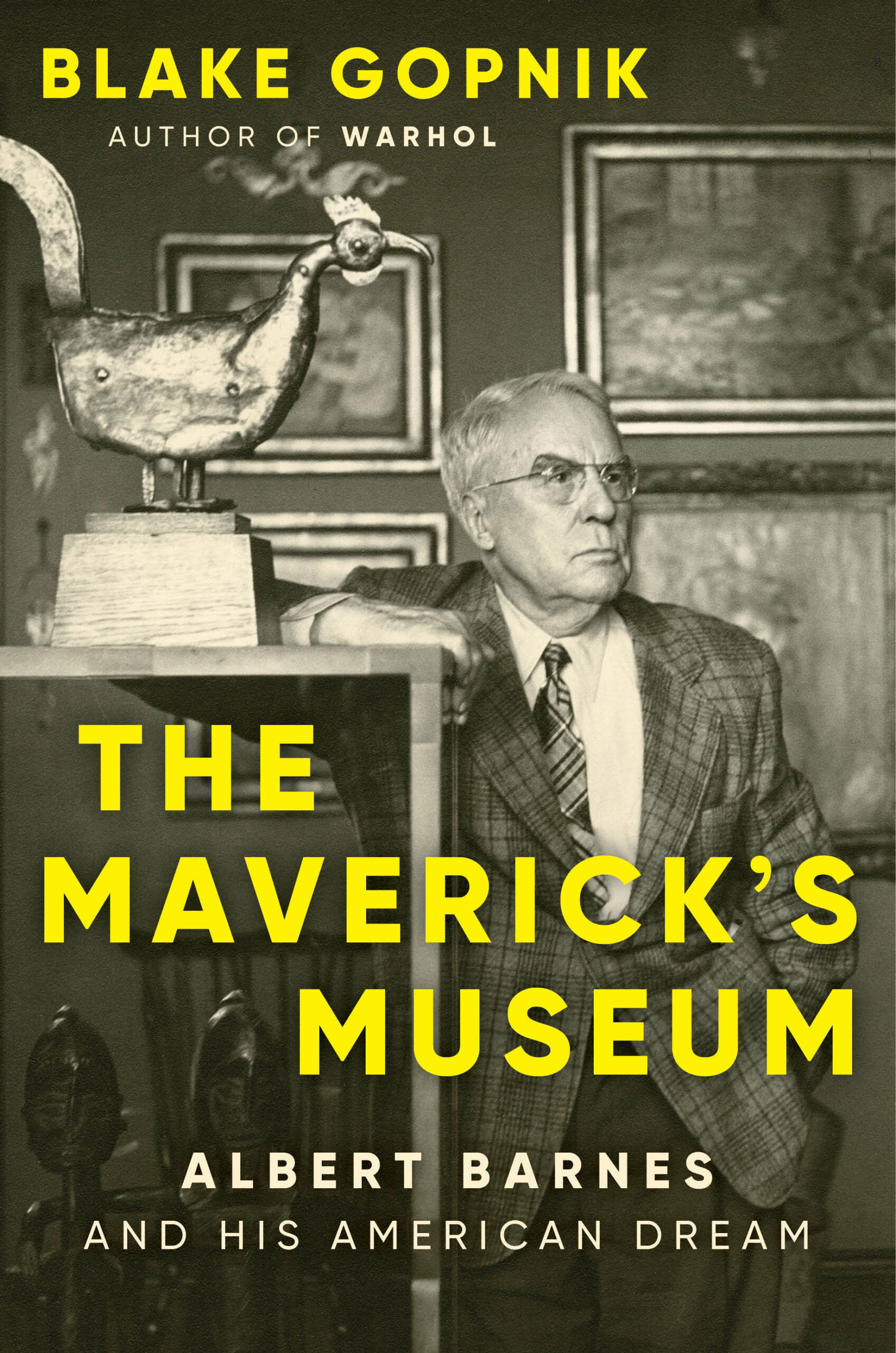
The Maverick’s Museum
The Maverick’s Museum explores the life of Albert Barnes, a chemist-turned-art collector who assembled a modern art collection he hoped would transform America’s soul. Barnes made a fortune with a medical breakthrough then poured it into art, filling his Barnes Foundation with hundreds of masterpieces to enrich the lives of everyday people.
Albert Barnes was driven by lofty ideals. Believing art could uplift society, he was determined to take culture out of elite hands and share it with ‘ordinary’ Americans. The Barnes Foundation wasn’t a typical museum; it was an educational experiment where working people could learn from art. Decades before the civil rights era, Barnes put his principles into practice, hiring African American workers in his factory and running classes for them two hours every afternoon.
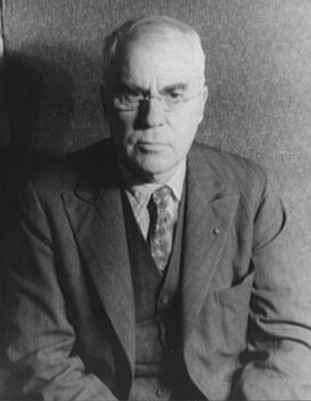
Albert C. Barnes
Photo credit: Carl Van Vechten
Wiki Commons
Yet this idealist was also combative. Ezra Pound said Barnes was ‘at war with mankind’, and Barnes feuded with the art establishment, firing off scathing insults and even signing letters with his dog’s name. Barnes’s ego and sharp tongue earned him as many enemies as admirers. He could be generous yet tightfisted, craving praise yet scorning authority.
Blake Gopnik’s biography grapples with these contradictions, painting a nuanced portrait of this eccentric art collector. The Maverick’s Museum shows how the ferocity of Barnes’s democratic ambitions left him with more enemies than allies, even as his passion for art education left a lasting impact.

A view of the northwest corner of the Barnes Foundation building in Philadelphia, 2015.
Blake reveals why he opened the The Maverick’s Museum with Barnes’s flamboyant arrival at a 1924 interracial banquet in New York and why he deliberately avoided a ‘drumbeat of nastiness’ in favour of balancing Barnes’s vituperative temper against his intellectual seriousness and generosity.
Writing history though the eyes of an individual
Blake also explains what drew him to Barnes: not just the man’s contradictions—generous yet tight-fisted, idealistic yet combative—but the promise of an enormous, largely untapped personal archive. He almost dispensed with interviews in favour of letters, receipts and records, arguing that documents ‘lie too, but at least you can cross-reference them’, unlike interview subjects who tend to repeat well-worn stories rather than genuine memories.
Our conversation traces Blake Gopnik’s search for a structuring idea, which only emerged months into writing when he discovered the American progressive era as the intellectual framework that made sense of Barnes’s collecting, his social reform impulses and his relationship with African American culture and the Harlem Renaissance.
Praise for The Maverick’s Museum
‘Gopnik ably illustrates the story of Barnes’s rise and his collecting, spiriting the reader along as Barnes flits from passion to passion, feud to feud.’
- Wall Street Journal
‘A vivid, engrossing biography.’
- New York Times
‘A clear-eyed assessment of a champion of modern art...a comprehensive portrait.’
- Kirkus Reviews
‘A vibrant and comprehensive portrait of an influential figure in American art history.’
- Publishers Weekly
‘Charming and fascinating …. The result of Gopnik’s prodigious research is a lavishly illustrated book rich with storylines….the Barnes is, at long last, a public institution. Hundreds of thousands of people now visit annually (this year, I hope, including me). Read the book, and you’ll want to go, too.’
- Washington Independent Review of Books
‘The Maverick’s Museum has many such illuminating insights and is enriched by Gopnik’s skills as an ace archival researcher. Chances are, after reading this lively biography of Albert Barnes, you’ll want to follow it by visiting the Barnes Foundation — and vice versa.’ - Hyperallergic

Blake Gopnik is the author of The Maverick’s Museum: Albert Barnes and his American Dream, a biography of the great American collector of modern art that appeared in spring, 2025, from Ecco at HarperCollins. His Warhol, the first comprehensive biography of the Pop artist, was widely acclaimed and received major international coverage when it came out in 2020. He has been the staff art critic at the Washington Post and Newsweek and is now a contributing critic at the New York Times. He has a PhD in art history from the University of Oxford and has been awarded fellowships at the Leon Levy Center for Biography at the CUNY Graduate Center and at the Cullman Center for Scholars and Writers of the New York Public Library.
Know more about Blake Gopnik? You’ll find him here: https://blakegopnik.com/
Episode transcript
Opening excerpt
Blake Gopnik: My role as a biographer is to write history that’s interesting and exciting and true—hopefully even insightful at moments—and to do that via an individual person, because that’s a really excellent way of writing popular history.
But I hope that even the most popular history, the most popular biography, has more in it than just pop psych. That’s the great danger we face: writing cheap novelisations of someone’s life and putting in too much pop psych.
Introduction
Gabriella Kelly-Davies: Hello, I’m Gabriella Kelly-Davies. Welcome to Season 5 of Biographers in Conversation. In each episode, biographers chat about the multiplicity of choices they face while crafting life stories.
I’d like to acknowledge Australia’s first storytellers, the Gadigal people of the Eora Nation. The Gadigal people are the traditional owners of the land from which I’m coming to you today.
You’ll find us wherever you listen to your podcasts and on our website, biographersinconversation.com. Let’s start the show.
In this episode of Biographers in Conversation, Blake Gopnik, an acclaimed art critic and biographer, chats with me about his choices while crafting The Maverick’s Museum: Albert Barnes and His American Dream.
This biography explores the life of Albert Barnes, who assembled a modern art collection he hoped would transform America’s soul. Barnes was driven by lofty ideals. Believing art could uplift society, he was determined to take culture out of elite hands and share it with ordinary Americans.
Yet this idealist was also combative. Barnes’s ego and sharp tongue earned him as many enemies as admirers. He could be generous yet tight-fisted, craving praise yet scorning authority. Blake Gopnik’s biography grapples with these contradictions, painting a deeply nuanced portrait of this eccentric art collector.
Blake, welcome to Biographers in Conversation.
Blake Gopnik: Thank you so much, Gabriella. It feels very natural to be talking to you about this because the editor on both of my biographies is named Gabriela. So talking about Albert Barnes feels extremely natural with someone called Gabriella.
Introducing Albert Barnes
Gabriella Kelly-Davies: That’s so good. Please tell us about Albert Barnes.
Blake Gopnik: Albert Barnes is one of the great characters of the twentieth century. He was born in Philadelphia, unbelievably poor, into the worst slums you could ever imagine. Then he pulled himself up by his bootstraps using his innate genius, made a drug that made a lot of money and used it to buy art.
He really lost interest in making money and continued to produce one drug that made enough money for him to build himself a private museum and buy—what is it?—75 Cézannes [figure to check], hundreds of Renoirs, before anyone else was really buying a lot of those things in the United States.
The first Van Gogh to enter the United States came through him. Then he spent the rest of his life trying to teach people about the modern art he loved, and mostly chasing people away from looking at the modern art he loved. He was a madman and a genius in almost perfect balance.
Finding the book’s heart
Gabriella Kelly-Davies: Please tell us about The Maverick’s Museum and what inspired you to write it.
Blake Gopnik: It’s a complicated book. My previous biography was about Andy Warhol. It was almost a thousand pages, so this book, at 350 pages, is barely a pamphlet in comparison.
But it was actually a more difficult book to write because Andy Warhol is straightforwardly one of the most influential geniuses in the history of art ever—certainly in the history of twentieth-century art. In a way, that was more straightforward, and he led an incredibly interesting life from beginning to end.
Whereas Albert Barnes was, in some sense, just an industrialist, just a drug maker who happened to buy art. So it was hard for me to find the heart of the book when I was writing it. It was obvious that he was an incredibly interesting man who was important in the history of collecting, and really in the history of thought about art in America. But it wasn’t obvious where I’d be able to go, or how I’d be able to go, with the book.
Other than knowing I was writing a biography of Albert Barnes—that was a given from the beginning—it wasn’t obvious to me. It was actually more of a challenge than the Warhol book. I have to say that it was probably six or nine months into writing the book that I started feeling comfortable about a theme, about ideas.
I’m very much an ideas person. Really, I’m a scholar manqué [word to confirm]. I need to have a thread of ideas, of concepts, of ideas I care about—my own ideas—in order to really embrace a subject. I just thought it was a wonderful opportunity.
But the honest-to-God truth is that I’m an archives rat. I just love digging into a good archive, and that really affected my decision to write this book. It was all very well to write about a collector who was extremely interesting, but the notion that I’d be able to access thousands and thousands of his records really turned me on.
Choosing the title
Gabriella Kelly-Davies: Yes, I’m an archive nerd as well. I’m also curious about the title. Why did you choose it?
Blake Gopnik: We worked like crazy. We tried a million titles for this book because, as with any book about a figure who isn’t wildly well known, it’s difficult. I have to admit, the title of my first biography was rather easy. It’s just called Warhol, and everyone knows who Andy Warhol is. It doesn’t take much to sell that book to readers, conceptually at least.
Whereas Albert Barnes is unknown except to all Philadelphians and anyone who loves twentieth-century art in America, and that’s not everyone in the world. So we went back and forth between putting Barnes in the title and then having a subtitle, or having the subtitle be the title.
But in the end, it was important to get across his character, his personality as a maverick: someone who did things that weren’t the normal thing to do, someone who intersected at angles with society. So the idea of the maverick was important to me.
He didn’t like to call it a museum. He thought his museum, in fact, was an educational institution. But it was important to give readers some idea right away that this was about a collector who wasn’t just a collector. We wanted to remind people as well that the museum’s still there. In fact, it’s more of a museum than ever before.
So we juggled lots and lots of ideas, and we thought this one was probably the best balance of all the things we wanted the book to talk about.
Gabriella Kelly-Davies: I thought it was brilliant. It told me from the very beginning, before I even opened the front page, what it would end up talking about.
Portraying a contradictory character
Gabriella Kelly-Davies: Albert Barnes, as I mentioned in the introduction, is a man of contradictions. How did you reveal these facets of his character?
Blake Gopnik: That was the great, important challenge of the book. I really wanted to [balance things] as well as I possibly could between the madman—the vituperative monster who was Albert Barnes—and the genuine genius.
And I don’t just mean genius collector, in that he bought all the right things. He wrote at vast length and I think was much more influential than people realise in the history of what’s called formalist criticism, in the world and in America especially: caring about pictures only for what they look like, not the subject matter they show.
I really was trying to balance that. I tried to sprinkle the two sides of his character throughout the book, but I didn’t want there to be a drumbeat of nastiness throughout it because I thought that would be a distraction. If you give people any nastiness at all, in a sense that’s all they can see, because it’s so much more fun. Mean people are so much more fun than nice people, and that’s a problem Barnes has always had over the years.
You’ll notice that there are moments where I dwell on his nastiness. I have a passage—it must be five or six pages—that just goes into it and tries to [deal] with it as a character trait. I come back to it here and there in the book—in fact, quite often—because it’s irresistible. He’s so vituperative in such an almost comical way, a deliberately comical way. He thought it was funny to be out of control. You just can’t resist it. It had to be there.
But I wanted it balanced by his intelligence and the importance of his ideas, and also his generosity and his importance, especially as a social reformer. I really wanted it to be clear that if you were to cut out all the passages about his vituperation, you’d actually find someone of importance, of generosity, who cared about little people, who cared about American life and American politics, and also African Americans.
That’s centrally important. His relationship to African-American culture and people really mattered to me a lot.
Reading: the Civic Club banquet
Gabriella Kelly-Davies: You opened The Maverick’s Museum with a scene in New York in which Albert Barnes made a grand entrance in a flamboyant car to attend a banquet for 200 people in New York’s only integrated private club. I’d love you to read some passages from it.
Blake Gopnik: Yes, I’m very happy to, except that whenever I read my prose aloud, all I can hear are the errors in it. I should have read the entire book aloud, and I would have done a much better job. We all should do that as biographers because that’s when you notice that a sentence is too long. But I’m going to do it.
The sun was setting on the unseasonably cold evening of March 21, 1924, when yellow cabs began to pull up in front of the grand old brownstone of the Civic Club, a meeting place for New York’s progressive elite on 12th Street in Greenwich Village.
From Harlem and other Black enclaves came a crowd of African-American writers, including the young poets Langston Hughes and Gwendolyn Bennett, as well as the new-minted novelists Walter F. White and Jessie Fauset, all in their best evening clothes. They were joined by the philosopher Alain Locke, a professor at Howard University in Washington who was a Harvard graduate and Rhodes Scholar, despite being African American, and by the activist and Black intellectual W. E. B. Du Bois, fresh from a trip to West Africa as President Coolidge’s minister plenipotentiary.
Bourgeois neighbourhoods of the Upper East Side and Brooklyn Heights delivered up leaders in progressive white culture such as H. L. Mencken and Carl Van Doren. They were joined by other whites, Horace Liveright and the other publishers and editors daring to promote the New Negro movement, just then being defined by the evening’s Black authors.
Even as cabs and passengers were gathering around the Civic Club doors, they found themselves giving way before a monster of a Packard sedan: a seven-seater straight-eight with butter-yellow wheels, a body painted indigo blue, and fenders and headlamps custom-enamelled in black. Climbing out of his seat up front, a chauffeur swung open the carpeted door of the passenger compartment to release an ox of a man in a double-breasted greatcoat and fedora.
White hair above beetling dark brows gave him the look of an ageing vice cop, someone who hit first and asked questions later, as this man did in all cultural fights. He was Albert Barnes, coming in from Philadelphia, where he’d first earned a fortune selling Argyrol, the gonorrhoea antiseptic, and then gone on to collect and show and throw punches for some of the newest modern art.
Cross him on matters aesthetic, and you were likely to be outed for “clandestine fornication”, as he said. He kept bail bonds at hand in case of arrest for libel. He happily admitted that his specialties were “vituperation and profanity”. He offered to settle art-world arguments with his fists.
That night in New York, Barnes, in a friendly mood for once, was joining a banquet attended by something like 200 people, both Black and white, in a city where the colour lines still went largely uncrossed. They were meeting in New York’s only integrated private club. Du Bois had been a charter member.
The affair was organised by Charles Spurgeon Johnson, the Black activist who edited the Urban League’s new Opportunity magazine, joined by Alain Locke as the evening’s master of ceremonies. The supper has long been considered the Harlem Renaissance’s coming-out party—the very words used to describe it in the next issue of Opportunity.
The party had been conceived to bring together a new generation of Black talent with white power players who had vision enough to appreciate “the significance of their work for America and present-day culture at large”, as Locke wrote in his letters of invitation to Barnes. The collector must have been surprised to be counted among those visionaries.
Some of the banquet’s diners might have read, and a few might even have remembered, the passing notice New York newspapers had given to Barnes’s announcement a year earlier that he had plans for a museum near his suburban mansion on Philadelphia’s ritzy Main Line. The museum would display the 600-odd works of radically modern art he’d amassed over just his first decade of buying—masterpieces that precious few of Barnes’s contemporaries would have seen as museum-worthy at all.
The press at the time noted Barnes’s stockpile of 150 Renoirs, 50 Cézannes, 22 Picassos and 12 Matisses, as well, said the press, as “this interesting collection of African sculpture believed by critics to be the most complete in existence”. Few guests at the Civic Club would have known more than that about this collection or its owner.
Among those Jazz Age partiers, the 52-year-old chemist stood out as notably stodgy. So, after listening to several speakers’ hopeful remarks about the bright future that must be just around the corner for America’s Black creators—“They sense within their group a spiritual wealth, which, if they can properly expound, will be ample for new judgment and reappraisal of the race,” said Locke in his comments—Barnes’s fellow diners must have been surprised and pleased to find him talking in quite concrete terms about the African ancestors of Harlem’s new talents. They would have been stunned to hear the strength of his support.
African art, Barnes insisted, “is as positive a form as Attic Greek art and as fine as anything in Egyptian art from 2000 BC to 5000 BC or in Greek art from the second to the sixth century”. [Dates and wording to check against the recording or book.]
Despite the money they had on the line, it’s not likely that even the most supportive of the white publishers on hand had ever argued—with reporters present, no less—that Du Bois and Locke were competition for Plato or even for John Dewey, or that Shakespeare and Henry James had better watch out for rivals like Langston Hughes and Jessie Fauset.
Most of America’s elite, immersed in an era of the deepest racism, would never have imagined that any creation by a Black person, anywhere at any time, could rival the heights of white culture.
By the next day, Barnes was doubling down on his claims in a note to his Civic Club host. He told Johnson that the Barnes Foundation, soon to open its doors, would be giving “a crack between the eyes” to the stodgy old art world by showing African and classical sculpture side by side, proving the contest at best a draw.
Ditto for those same African works and the art of the latest innovators, such as Picasso and his followers, who could normally count on Barnes as their champion. “I have in my house ample proof in the works of these moderns that much of their inspiration came from ancient Negro art,” he said. “Negro” was the standard polite term at the time. It was the period version of today’s “African American” or “Black”.
Unlike most of the era’s white fans of African art, Barnes wasn’t admiring it for the thrill of a charge that would have been labelled “primitive”, as the product of some exotic other that stood for a disruptive force that was “against everything”, as Picasso put it. Barnes was bringing African art right into the fold of all the high culture he and other aesthetes were supposed to admire. And he was using it as a sign of the respect that all Black people and their cultures were owed.
Why begin with this scene?
Gabriella Kelly-Davies: Blake, that is just so brilliant. Why did you open the book with this scene?
Blake Gopnik: Certainly one of the things I found most compelling about Barnes was his relationship with African-American culture and African-American people. Among people who are Barnes aficionados—and there are a few of us out there—that’s certainly not a hidden fact. But I think the general public really knows him mostly as a collector of art by white people.
So it was really important for me to [bring out] this particular aspect of his character and of his life as a patron and a cultural figure. Especially today, when those issues are so front and centre in American culture, to see that they were for this man operating in the 1920s, and before and after, hopefully gave my readers some direct connection to him: to see that these issues were alive then and are alive now.
It’s been exactly 100 years since he opened his museum to the public [anniversary reference to check]. I just thought it was a lovely hook to get readers interested in the man and everything else he did.
There was no one, or virtually no one, in white American culture who would have been willing to say things like what he said at that dinner. The idea that the art of Africans was just as good as Praxiteles, as the art of ancient Greece, would have been utterly shocking to most whites and, for that matter, to most Blacks. No one had really said it before.
Tutankhamun’s tomb had been uncovered two years before Barnes made that speech. So to compare African art to the glories of the newly discovered Egyptian art—there was a real Egyptomania happening right then—was a really daring move.
That just shows you the good side of Barnes that can get buried under his vituperation. He was very happy to vituperate in favour of Blacks as well. Even in those cases, his comments can be so nutty that you forget there’s real substance under them.
Finding texture in the archive
Gabriella Kelly-Davies: Yes, we learned so much about Barnes in that opening scene. You admitted that you’re an archive rat. How did you research Albert’s life, and which sources were most revealing?
Blake Gopnik: It was such a pleasure to go through the random little documents in his archive, like all the receipts for all his cars, for all the work that was done on the cars and all the customisation. He changed cars every year. That kind of detail is just a joy to have at your fingertips.
You can be, as it were, a novelist without having to imagine any of it. You have that kind of texture, which I really love having at my fingertips. That was a real pleasure in writing the book, and very important to me.
He was a madman for keeping his letters. He kept many of them in triplicate or quadruplicate, and kept both the letters he sent and the letters he received. So there’s everything from letters from his milkman and his paper deliverer to a huge trove of letters to John Dewey, the great philosopher.
Obviously the letters are amazing—the letters to Dewey or to Leo Stein, who’s an important thinker and collector of art, for that matter. That’s all great. But without the other stuff, without the detail about his everyday life, I wouldn’t have been able to write the book I was trying to write. Not to mention receipts for all the art he bought, which were very important as well.
Interviews, memory and verification
Gabriella Kelly-Davies: I love all those little things, like bus tickets and passport entries and all those sorts of details. What role did interviews play in your research?
Blake Gopnik: I believe they played absolutely no role whatsoever. In my Warhol book, I interviewed almost 300 people. As you know, interviewing people is a tricky business because mostly they tell you stories they’ve told a hundred times. They don’t actually give you memories; they give you stories that they’ve potted.
It was kind of a pleasure to have documents instead of people to deal with in this case. Documents lie too, but at least you can cross-reference them and try to fact-check them.
I don’t think I did a single interview. Maybe I did one interview with someone who’d been there in the 1960s. But the book really ends in 1951, so it’s not surprising there wasn’t really anyone alive to interview. I don’t think there’s a single person who actually knew Barnes still alive today.
Gabriella Kelly-Davies: It’s interesting. In my doctoral thesis, I talked a lot about memory and really studied it: how we re-remember an event each time we remember it, and how, in biography, people embellish either through nostalgia or through misremembering. Also, they don’t want to be seen as saying anything negative about the person in case it affects their relationship with that person.
Blake Gopnik: Or they want to do the opposite. They want to say only negative things that are undeserved by the poor person.
Gabriella Kelly-Davies: Exactly. They want to assassinate their character, which happened for me with a couple of people I interviewed for a biography I wrote. When you do interviews, it’s very complicated trying to verify what people say because of all those sources of error.
Blake Gopnik: Of course, they also want to tell a good story because an interview is a social moment. They want to please you and impress you. When we talk, we try to talk well and interestingly, and if that involves saying things that didn’t actually happen, we do it anyway.
Gabriella Kelly-Davies: Yes, and the stories evolve over time. The more they tell them—and this is the same if you interview the subject—the more you get the same old stories, time after time, that you’ve read in newspapers and various places. It’s not until you go digging deep, looking at the archives, that you find the truth.
Blake Gopnik: Or a version, a plausible version of the truth, that might actually differ from what you’ve been told by the subject themselves or the other interviewees.
Evidence, attribution and endnotes
Blake Gopnik: I think in the Barnes biography, maybe unlike my Warhol biography, I was mostly able to do what I like to do, which is not say, “This is what happened,” but, “This is what so-and-so said happened”—make it very clear where the stories come from. In Barnes, I could just quote letters and say, “This is what he said,” rather than saying, “This is what he did,” in a sense.
There’s a lot of factual material in the book. I hope it doesn’t weigh it down in any way, but it’s very heavily endnoted. I really tried to endnote almost every single claim I made, which is shockingly rare. I can’t tell you the number of biographies I read where there are endnotes, but half the facts, half the claims they make, aren’t endnoted. I tried to give an endnote for every single fact in the book.
Gabriella Kelly-Davies: Readers want to know, and have the confidence, that what you’re telling them is correct because we have a contract with readers to tell the truth, or a plausible version of the truth.
I think endnotes in biography are essential. There’s no way I’d read a biography if it didn’t have endnotes because I wouldn’t know then what version of the truth I was reading, if at all.
Blake Gopnik: [Opening words missing] biographies, the endnotes are available online, not in print, partly because of the cost of the paper. My endnotes for the Warhol book, I think, are 700 pages alone—just the endnotes—and there was no way they were going to publish a separate volume just for the endnotes.
But there’s a big advantage to having them online, which is that I can add to them and correct them. People can read them, have them on their phone while they’re reading the printed book. It’s actually quite a nice way to read the endnotes, to have them available as a separate document. That’s worked well for me.
Of course, that’s happening more often for everyone, given the cost of printing today.
When to start writing
Gabriella Kelly-Davies: When in the research process did you start drafting the manuscript?
Blake Gopnik: I always start doing that quite early. I think it’s a big mistake [phrase incomplete]. With Warhol, I waited a little too long to start because you can end up doing research for the entire time you have at hand to write the thing. Then you run out of time and run out of money, and you’re writing like a mad person.
I also don’t have a great memory, so I need to write in chunks while the research is still fresh. When you’ve got archives like the Warhol archive, which was just as big and crazier than the Barnes archive, it’s impossible to keep it all in your head. You really have to write while what you’ve seen is relatively fresh.
Reading: childhood in the Neck
Gabriella Kelly-Davies: After the prologue, in which we’ve talked about Barnes in his heyday, you wrote about his childhood in a desperately impoverished slum known as the Neck. Would you please read the opening passages of this chapter, titled “The Neck, Central High”?
Blake Gopnik: I’d love to. It’s one of my favourite bits of the book.
“A desolate, godforsaken, filthy, ill-drained place, not fit for dogs to live in, and altogether unsuited for families, where decency is out of the question and degradation certain,” said Philadelphia’s health inspectors in 1867.
This was the Neck, filling a dank expanse of land at the far south end of Philadelphia, where its two rivers met and often flooded the hovels between them. In the decades after the Civil War, the near-destitute came to the Neck for squatters’ housing set amid the waste heaps from soap factories. Stagnant ponds came slicked with rainbows by the nearby refiners of Pennsylvania’s new oil.
Those health inspectors described the neighbourhood’s residents as “half-civilised and half-human beings living in ignorance and wretchedness”. According to an 1881 issue of Scribner’s Monthly, if a family could grab and drain a stretch of soil, they might start a truck farm fertilised with their own faeces—as Scribner’s put it, “that substance gathered in the night which they would not give up for the most approved of phosphates”.
In Scribner’s, all this could come off as picturesque, according to the era’s Dickensian romance of destitution. But for a young Necker named Albert Barnes, it was indescribably grim. A friend of Barnes who had gone slumming in the Neck as a youth recalled having been “in mortal terror of meeting gangs of hoodlums”.
Barnes himself got beaten by local bullies who stole the toy tops he’d scrimped to buy. In self-defence, he taught himself to box by sparring with his brother and watching the local bouts. “At 11, boy in tough neighbourhood learns to fight,” he wrote in notes on how he profited from his rough early life.
“When I was a boy down in the Neck,” Barnes recalled, “when fresh kids made themselves a nuisance, their companions knocked them down and spit on a part of their anatomy that is usually kept covered.”
Barnes hung around the notorious Vare brothers, Neckers who rose from selling potatoes door to door to being some of Philadelphia’s most powerful and corrupt political bosses. The youngest of them, Edwin H. Vare [birth order to check], later became a neighbour of Barnes among the mansions of Philadelphia’s Main Line. One day, when one of the Vares came at Barnes with a shovel, Barnes knocked him cold with a bottle.
For the rest of his life, in whatever he did, Barnes kept his chin down and delivered a roundhouse before an opponent’s guard was even up. As Barnes concluded, grimly but with some obvious pride, “Early habits crop up later in life.”
Those years in the Neck could be blamed on his father. Albert Barnes spoke bitterly of the failings of his tobacco-chewing dad. More than a quarter-century after his amputation, John Jesse Barnes could be found “stiff drunk” in a basement and chasing one of his son’s employees with a hatchet.
In 1904, John Jesse Barnes took an oath to stop drinking, but it didn’t stick. He would disappear for days at a time as his wife searched for him in tears. One observer called Barnes’s father “utterly illiterate, vulgar, immoral”, and described his assignations with a scrubwoman’s daughter.
Barnes himself described his father as having “a good intelligence and tremendous energy” but as “lacking character” and as having been essentially missing as a parent. “Unfortunately, I needed a father,” Barnes wrote to a friend in 1920, when John J. still had a decade left to live.
And yet, for all Barnes’s reputation for being brutally focused on his own advantage, he supported his father right until his death, shoring up the veteran’s finances and paying the crippled old man’s sometimes weekly medical bills. When John J. Barnes died of a heart attack in 1930, Albert gave him the final honour of a tombstone that listed him as serving for all four years of the Civil War, rather than for his real six months.
In May of 1912, Barnes explained the reason for the following decades of filial altruism, despite all his reservations about his old man. “It is my intention to make the remaining years of my father’s life worthy of my mother’s memory,” wrote Barnes. Lydia Barnes had just died at the age of 65, and she’d been the major force in her famous son’s development.
“I had a marvellous mother, one endowed with a keen, penetrating intelligence,” Barnes wrote. He had, in fact, supported that mother in secret from the moment he’d become wealthy, and the savings she died with had actually come from him all along.
A decade after her death, he had planned to call his celebrated foundation after her. But in the end, he chose to call it the plain Barnes Foundation. According to her son, Lydia Barnes had “a courage equal to Roger Baldwin”. He was the beleaguered conscientious objector who had co-founded the American Civil Liberties Union. Looking for a model of courage, Barnes instinctively turned to a left-wing reformer.
But best of all, Barnes said, his mother had “poise and balance”. He knew those two virtues had passed him by. “I came into the world maladjusted, and I’m still that,” Barnes wrote.
Contrasting poverty and prosperity
Gabriella Kelly-Davies: That’s extraordinary. Your description of the area is so vivid and graphic. I read it several times because it brought up the image. I felt like I was there in the moment, in the scene.
Blake Gopnik: I hope you didn’t feel too much like you were there because it’s not a pretty scene. I hope you didn’t start smelling the mud of the Neck.
Gabriella Kelly-Davies: What it did for me was really help me understand why Albert Barnes was the way he was. In fact, what I wanted to ask you is why you juxtaposed his prosperous adult life in the prologue with his impoverished childhood in this first chapter.
Blake Gopnik: In a way, it’s kind of natural. It’s, I’m afraid to say, almost a cliché, but a cliché that works well. I think very few biographers start with the childhood because it can be a little tiresome. Many childhoods are rather similar. Barnes’s wasn’t, but many children have similar childhoods. Of course, you don’t get to the grown-up for a long time if you begin your book with the childhood.
It’s kind of standard now, as you obviously know, to begin with something salient in the life, and that’s why I chose that scene in 1924 at the Civic Club dinner.
So, in the second chapter, I did need to get to the childhood, but it happened to work out extremely well in this case because the contrast is so extreme. The man who grew up in dire, grotesque poverty becomes very rich, becomes a collector, becomes an intellectual. That contrast is vital to understanding the man and is there throughout the whole book.
It was a pleasure to be able to have that play out in the first two chapters. Sometimes, if you’re lucky, your subject gives you things like that. If you’ve got someone as interesting as Barnes, as varied in experience as Barnes, it makes it a little easier to write a biography.
Structuring the turning points
Gabriella Kelly-Davies: What were the key turning points in Barnes’s life that you knew had to be anchor points in the book’s structure?
Blake Gopnik: Certainly his rise to get a good education, which was unlikely for someone from the Neck: the fact that he went to the University of Pennsylvania and got a medical degree. The education was very important because he had a surprisingly good one, one you really wouldn’t have expected for someone from such humble beginnings, especially in the 1880s.
Then his discovery of Argyrol, his invention of Argyrol, which was the gonorrhoeal antiseptic that made him rich. It was very important to capture him as a chemist, capture him as a businessman, because that was very important to who he was, and then move on as quickly as I could to the moment he starts collecting. Because if he matters, it’s because of the art he bought.
It’s amazing to me—and of course I only realised this halfway through the biography—that he really didn’t care about money as much as you’d think. If you talk about an industrialist, a magnate, all the words that are applied to him, you expect someone who really cares first about money and then cares about the things they buy with their money.
But he could have made more drugs. He could have made more Argyrol than he did. Once he was making enough money to be filthy rich compared to a biographer—but not Rockefeller-rich by any stretch of the imagination—he let the factory really take care of itself. He never expanded it. He never tried to make more money than Argyrol brought in naturally because it was almost mandated that a drop of Argyrol be put in each eye of every newborn infant so they wouldn’t get gonorrhoea from their mother’s birth canal.
That provided a very nice income for the rest of his life. I needed to establish where that income came from and then show him collecting art. At that point, he had to collect art.
Along the course of his life, there were various incidents that needed to be highlighted. But unlike my Warhol biography, which functions a tiny bit like an encyclopaedia of Warholiana, the Barnes biography didn’t need to do that. There’s a decent literature on Barnes already. There are a couple of earlier biographies, including one written fairly soon after his death that interviewed a lot of people. So the basic facts of Barnes’s life are pretty well known.
No one has had access to the archive before, so that makes a big difference. But I didn’t feel I needed to do a year-by-year account of Barnes’s life. I really wanted to hit on the things that mattered to understanding him and his art.
Discovering the Progressive Era
Gabriella Kelly-Davies: How did you place him within the broader historical and social context of the times?
Blake Gopnik: That was really important to me. It was a major turning point in writing the biography, and I’m sure this happens to most biographers. I was tootling along trying to put together a biography of Albert Barnes, but I didn’t have something to say. I didn’t have a claim to make. I didn’t have an angle on him, and that was distressing me.
I traded apartments with some friends in London. I live in New York—actually a block from Times Square—so we’re quite lucky that so far no fire engines have gone by, as they normally do. It so happens that the friend I was borrowing the apartment from had a bookshelf full of books about the Progressive Era. She was writing a book about the Progressive Era in America.
It’s a very special thing. There was this moment of really forward-looking politics and forward-looking social thought, which I vaguely knew about, but not really properly. It was being in London and reading her books about the Progressive Era that made me realise Barnes can be situated entirely in that. Almost everything he did, even his art collecting, had to do with these particular ideas about how America could move forward to being a better place than it was, how the evils and inequities of the Gilded Age could be corrected.
That was really the context Barnes was working in. That was the world of ideas he was working in and, in a sense, it was the America he was working in: an America where the evils of the Gilded Age were being corrected—or at least there was an attempt to correct them. That was the world he was moving in.
It really was wonderful once I discovered that angle that I could apply to understanding Barnes in a social context. Before I was a biographer, before even I was an art critic, I was trained as a historian, a social historian. That was important to me. It’s always vitally important to me to set the scene, to put someone in the context of their times.
Interpretation and judgement
Gabriella Kelly-Davies: You did it very well. To what extent did you interpret Barnes’s character, personality and behaviour versus providing the evidence and leaving readers room to form their own judgements?
Blake Gopnik: Generally speaking, I’m not a huge fan of judging the figures of history. I don’t know that that’s terribly useful. But Barnes is such an unsubtle character that if you just print a few of his letters and quote some of his actions, both good and bad, his character comes clear very easily. You don’t have to do a lot of work.
Finding an authorial voice
Gabriella Kelly-Davies: That’s right. How would you describe your authorial voice in The Maverick’s Museum?
Blake Gopnik: Oh boy, that’s really for someone else to say. One can attempt an authorial voice and have it fail entirely. I could say I was trying for a wry, playful voice, and someone will tell me, “No, not at all. It’s dry and academic.” You never know. Everyone reads the author’s voice differently.
But I did want it—I hope it was a tiny bit playful because he’s such a character that if you came at him too soberly, it would seem silly in a lot of ways. I hope there’s a lot of analysis of his ideas in it, but I wanted it to be a lively book because he’s a lively figure.
He’s an unknown figure, so you can’t expect people to read a thousand pages of dry prose about a figure they don’t know. I hope I achieved a slight, wry, ironic distance from the man, which you need when you’re dealing with someone as nutty as him.
Balancing the two voices
Gabriella Kelly-Davies: I think you did achieve that. It was a very propulsive narrative that really took the reader along with him and his eccentric ways. How did you balance your voice as the author with his voice? Because his voice was so distinctive.
Blake Gopnik: I hope I presented lots of his voice. The temptation—and I’m so guilty of it every time I write a biography—is that you find one great quote, one great letter after another. The hardest thing, I think, for a biographer who’s got an archive at hand the way I did with Barnes is not putting in all the great material you’ve got, because there’s so much of it.
Earlier drafts had much more of him, and I realised at a certain point I just had to cut out some of my favourite bits. I had to kill some of my children.
Gabriella Kelly-Davies: Kill some of your darlings.
Blake Gopnik: Yes, exactly. But I hope I balanced that as well as I could. I did want there to be some analysis, so all the stuff about the Progressive Era is my voice as a historian.
The truth is, I’m a biographer by default, but I’m a historian first and foremost. Biography is a very good way of giving readers history, and that’s really what my aim is. I’m not a novelist. I’m not a failed novelist. I’m not a wannabe novelist. I don’t know that I’ve ever written a page of fiction in my life, unless you count all of my Warhol biographies [wording unclear]. I want to get across history, and that’s my goal.
Biography as social history
Gabriella Kelly-Davies: I think that’s the beauty of biography: we see history through a person’s eyes and through their lived experience.
Blake Gopnik: That’s right. They’re an excellent hook to hang history on. There is a real danger. I was trained at the moment when the great-man theory of history—or even the lowly-man theory of history—was not acceptable, let alone popular. That is, history was forces, and I still believe in that.
There’s a danger with biography of turning larger social phenomena, larger social forces, into a story about one person. That doesn’t seem right to me. But a person lives within history, lives within a society, and if you can use them as examples of what the society is like and how it works, I think that’s quite powerful.
Reading: the foundation today
Gabriella Kelly-Davies: You wrote an epilogue discussing the fate of the Barnes Foundation after Albert Barnes’s death. I’d love you to read its opening passages.
Blake Gopnik: I’d love to do that. Thank you.
On a March day in 2024, 99 years after the public opening of the Barnes Foundation, I took a final look at the place as I prepared to wrap up this biography. I wandered among the foundation’s pictures, hinges and hope chests, displayed just as they were on the day Albert Coombs Barnes met his end in 1951.
I was joined by clutches of visitors from France and Japan, from Texas and Montana, from North and South Philly. In the two-storey main hall, we marvelled at its 24 Renoirs, 17 Cézannes and its landmark Seurat—works that had shocked their contemporaries but now seemed the safest of masterpieces.
I was particularly taken with the gallery’s west wall. By pairing the female models in the Seurat with the male card players in the great Cézanne below it, Barnes—or maybe his unconscious—had given us a little study of attitudes to gender in his day. Women, naked and passive, are set out on offer to a male observer. Men, clothed and engaged in the Cézanne, go about their business without an onlooker in mind.
This reading of mine wasn’t, and needn’t have been, available in the phone app that offered basic thoughts and data about almost any Barnes picture you could snap. And it certainly wouldn’t be found in any of Barnes’s own writings. But that’s the way of his foundation in the twenty-first century. Visitors are welcome to think their own thoughts about the works on view, or none at all if they prefer basking to ratiocination. The ghosts of Barnes and de Mazia, his assistant, barely hover.
That freedom of thought struck me again upstairs in the museum, where I spotted local college students taking notes on the African sculptures and the Modiglianis still hanging near them. Seven decades after Barnes’s death, those notes were less likely to reflect on his concept of plastic form—the concept that was so precious to him—than on racist colonialism and its effects on culture, as we might think about now.
But I admit to having been most compelled by how that gallery, like all the others at the foundation, opened a window onto the history of taste from a century ago, and onto a past culture’s ideas about art and the world. The Barnes doesn’t stop you from analysing a single picture, like an insect pinned down for inspection. But like all the other great house museums, in total it preserves a rare, unchanging record of what one obsessive art lover had in mind to do with his prizes.
Stepping out of the galleries, I and my fellow art lovers no longer took in the swelling lawns I’d found on a first visit as a tweenager, decades ago when de Mazia still held sway over the foundation. Instead, today we emerged into a soaring, skylit atrium. In one corner, a café; in another, a white-cube space reserved for whatever non-Barnes art the foundation might want to show.
Ending the biography
Gabriella Kelly-Davies: I really like that. Why did you choose to end the biography this way?
Blake Gopnik: The truth is, at a certain point in the draft of the book, I had ended it more abruptly than that. He has this horrible car crash that’s his own fault, that he dies in, and I wanted that really to be the loud final punctuation mark in the book. So after that, I had just bullet points about what happened after his death. I liked the idea that a biography begins with a birth and ends with a death, and can end there.
But a lot of people felt that there was so much history of what happened after his death, and a lot of it was very contentious because his will was broken in order to bring the museum to where it is today in downtown Philadelphia, which is something he’d absolutely forbidden in his will. That was in the early twenty-first century.
There was so much post-Barnes history that there needed to be some account of it. That’s why I switched to first person for that part of the book, because I wanted it to read as something absolutely different. There’s not a single “I” in the rest of the book, but I really wanted it to be my analysis of a situation that happened much later than the rest of the book.
The biographer’s role
Gabriella Kelly-Davies: I found it very powerful. Just in closing, what do you believe is the role of a biographer?
Blake Gopnik: Wow. I don’t know that I believe something particular about the role of a biographer in general, but my role as a biographer is to write history: to write history that’s interesting and exciting and true—hopefully even insightful at moments—and to do that via an individual person, because that’s a really excellent way of writing popular history.
But I hope that even the most popular history, the most popular biography, has more in it than just pop psych. That’s the great danger we face: writing cheap novelisations of someone’s life and putting in too much pop psych.
I’ve got a sister who’s, if I say so myself, a famous experimental psychologist, and I just want her to read this without feeling that she’s reading Pop Psychology magazine. If I can achieve that, if I can make my historian friends happy and make my sister not cringe at what I’m writing, then I’m happy.
Closing reflections
Gabriella Kelly-Davies: We’re biographers, not psychologists. It’s not our role to be pop psychologists.
Blake, thank you so much for chatting with us about Albert Barnes. Reflecting on his life reminds us of the power of biography. We’re left with a renewed respect for the biographer’s craft, which combines painstaking detective work, historical insight, interpretation and empathy. It sparks our intellectual curiosity, leaving us inspired to learn more and appreciate the insights one life can reveal about what it is to be a human being. Thank you so much.
Blake Gopnik: Thank you, Gabriella.
Credits
Gabriella Kelly-Davies: Thank you for listening to Biographers in Conversation. Special thanks to my producer, Andy Marr; web manager, Dylan Hamilton-Foster; and Sonny Lauderdale for the music.
We’d love you to take a moment to rate the show on the website, across social media, Apple, Spotify or wherever you find your podcasts. If you enjoyed this conversation, please share it with your family and friends and on social media.
To discover more about my guests and their biographies, head over to their show pages on biographersinconversation.com. There you’ll find all our episodes and ways of getting in touch with us.
I’m looking forward to our next conversation about the choices every biographer faces. I hope you are too.